Sabri Lamouchi Tactics At Tunisia 2026: Can The Eagles Of Carthage Finally Reach The World Cup Knockout Stage? – Tactical Analysis

Tunisia will participate in the FIFA World Cup for the seventh time this year, with the main target being to qualify for the knockout round, something they are yet to do in a World Cup.
Four years ago, Tunisia collected four points but still failed to qualify for the knockout phase, mainly because Australia earned more points to join France in the next round.
Despite beating France and drawing with Denmark in 2022, these results were still insufficient for them to pass the group stage.
This time, things are looking more complicated for Tunisia on paper, as they will be playing in a very tough group with the Netherlands, Japan, and Sweden.
In this tactical analysis, we explore Tunisia’s strengths and weaknesses, their style of play under Sabri Lamouchi tactics, and their predicted lineup for the tournament.
Tunisia Predicted Starting XI & Formation
Following Tunisia’s poor showing in the latest AFCON, Sabri Lamouchi was appointed to lead the team at the World Cup, resulting in some significant changes within the Tunisian national team.
In particular, Lamouchi brought a new mentality to the team compared to his predecessor, focusing extensively on the younger generation and trying to build a new team around a mix of younger players while avoiding the more experienced ones like Ferjani Sassi, Ali Maâloul, Yassine Meriah, Aïssa Laïdouni, Seifeddine Jaziri, and Naïm Sliti.
Lamouchi quickly implemented his tactics and built a competitive group by retaining notable team players and adding new names such as Rayan Elloumi, Khalil Ayari, Rani Khedira, and Moutaz Neffati.
Lamouchi’s changes impacted the goalkeeping spot as well, since he avoided keeping the same old hierarchy and preferred to rely on younger, more promising, and skilful goalkeepers like Mouhib Chamakh and Sabri Ben Hessen, who have been tested and proved their reliability.
Crucially, Lamouchi brought a new tactical identity and ideas to the team and is actually applying them progressively, with the hope of reaching the World Cup with 100% readiness, chemistry, and understanding of these ideas on the pitch.
Lamouchi’s ideas for Tunisia’s participation in the World Cup are centred around solid, patient, and disciplined defending, along with the ability to launch extremely quick attacking transitions to punish the opponent whenever possible.
To achieve this objective, Lamouchi is relying on quick players for executing the attacking transitions and is giving a lot of importance to this specific phase.
In the friendly games against Canada, Haiti, and, more recently, Austria, Tunisia were much more dangerous and quicker in their attacking transitions, demonstrating quality passing, chemistry among the players, and a reliance on key attackers in 1v1 duels.
Since Tunisia will be facing teams that are more likely to have more possession and try to impose their game, this will certainly put Tunisia in a situation where they are prepared to deal well with.
Getting used to being the underdog and exploiting the space behind the opponent’s defensive line has become one of Tunisia’s strengths since Lamouchi's arrival.
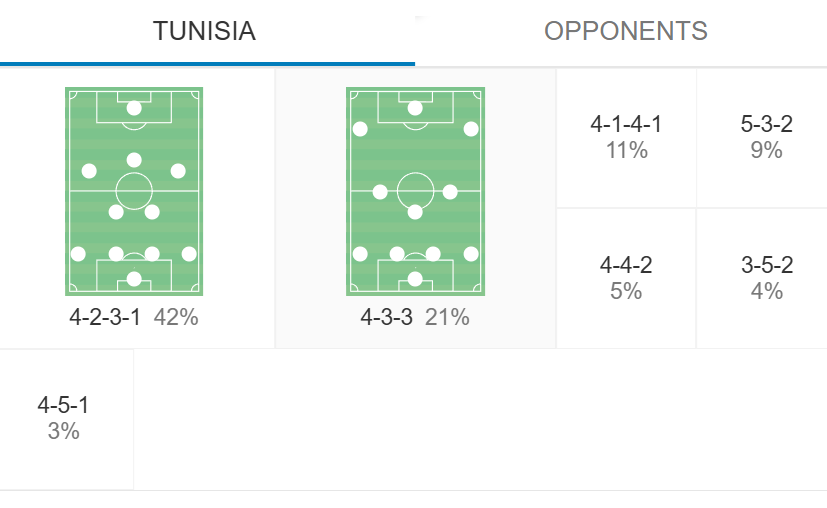
Lamouchi plans to rely on the 4-4-2 formation in the defensive phase in order to guarantee more compact lines of defence, while having more chances of making high recoveries too, while keeping a 4-2-3-1 formation when attacking.
This change in formation was seen against Austria and will likely be repeated at the World Cup, as it promises to make Tunisia more balanced and efficient in both phases if executed well enough.
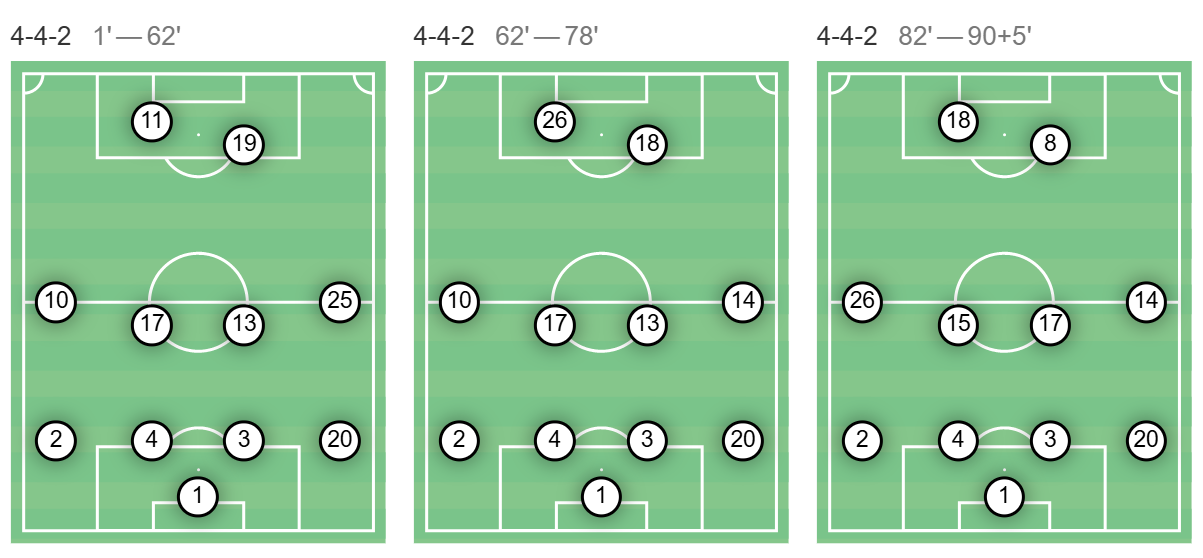
The following graphic shows the 4-4-2 formation Tunisia used against Austria and will use at the World Cup, with Hannibal Mejbri the first player to initiate the high press alongside Firas Chaouat, while Ismaël Gharbi presses from the left wing and Anis Ben Slimane from the right.
When attacking, Mejbri retreats to midfield and becomes the advanced playmaker, keeping Chaouat as the main striker, with two wingers on the same line as Mejbri, and two central midfielders in Ellyes Skhiri and Rani Khedira.
Lamouchi’s tactical choices suggest that Tunisia will avoid back-three formations during this World Cup and rely solely on a back four.
During the games played so far, Lamouchi has not gone for back-three formations and has preferred those with four defenders.
He will most likely rely on the 4-2-3-1 formation as the main one, while resorting to the 4-4-2 formation when out of possession.
As a plan B, Tunisia might also switch to the 4-3-3 formation, adding a more defensive midfielder, such as Mohamed Hadj Mahmoud, to replace Mejbri, forming a more compact midfield trio.
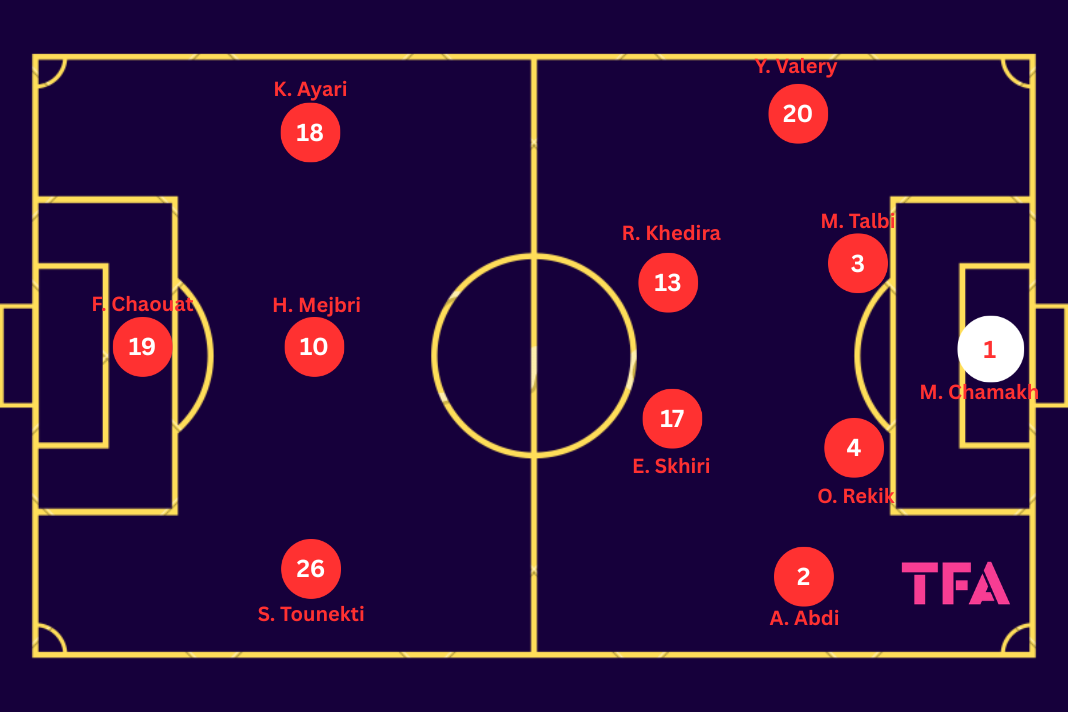
Regarding the best possible lineup for Tunisia during the World Cup, the Eagles of Carthage will be starting the tournament most probably with Chamakh as the first-choice goalkeeper, with Aymen Dahmen and Sabri Ben Hessen being two goalkeepers who are very close to Chamakh in terms of quality.
The advantage Chamakh has over the other two goalkeepers is that he plays with greater confidence and fewer errors with the ball at his feet.
For the defensive line, the best possible defensive duo will be Montassar Talbi and Omar Rekik.
All of Dylan Bronn, Adem Arous, and Raed Chikhaoui are going to be backup defenders.
On the right, Yan Valery is the confirmed first-choice right-back for Tunisia, with Moutaz Neffati the backup.
On the left, Ali Abdi will also be the starting left-back, as he has a lot of advantages over Mohamed Amine Ben Hamida and Mortadha Ben Ouanes.
The midfield will be made up of Ellyes Skhiri and Rani Khedira, with Mejbri as the advanced playmaker, and Hadj Mahmoud as the backup midfielder.
Sebastian Tounekti will be the preferred choice on the left wing, with all of Elias Saad and Elias Achouri being solid alternatives.
On the right wing, Lamouchi will mainly use Khalil Ayari as the first-choice right winger, with Anis Ben Slimane and Gharbi as plan B options for that role.
In fact, Ben Slimane can play in more than one position in midfield and in attack, as he can play as a right winger, an advanced playmaker as a backup for Mejbri, or even as a central midfielder as a backup to Khedira.
Gharbi also represents another joker card for Lamouchi since he can play in all of the three attacking spots: advanced playmaker, right winger, or left winger.
For the striker role, the first choice for now is Chaouat, with Hazem Mastouri not being very convincing in the last period.
Rayan Elloumi is also expected to get some playing time as a substitute to Chaouat as Lamouchi needs his pace and agility in counterattacks.
Tunisia Out-Of-Possession Tactics
When it comes to Tunisia’s defensive phase, which will be extremely crucial in this group stage, we can say that Tunisia can do well defensively if they maintain consistency in performances and, more importantly, in player choices.
Keeping the same defensive players will be crucial to ensure more chemistry and understanding between the players ahead of the first match.
This will help Tunisia a lot, especially because they are having a new defensive duo that needs some time to get used to each other.
For the full-backs, things are slightly more obvious as Abdi and Valery already have the experience needed on the flanks with Tunisia.
That said, communication between them and the two centre-backs will be necessary in order to avoid marking issues or passing misunderstandings.
Lamouchi’s decision to use a 4-4-2 formation will further support the backline, as the second line of defence will provide significant help in preventing penetrations and passes between the two lines.
Furthermore, moving Mejbri forward to contribute consistently with high pressing will help increase the team’s high-recovery rate per game.
Recoveries and high recoveries will be among Tunisia’s most important attacking solutions in this tournament, as they will create Tunisia’s counterattacking opportunities.
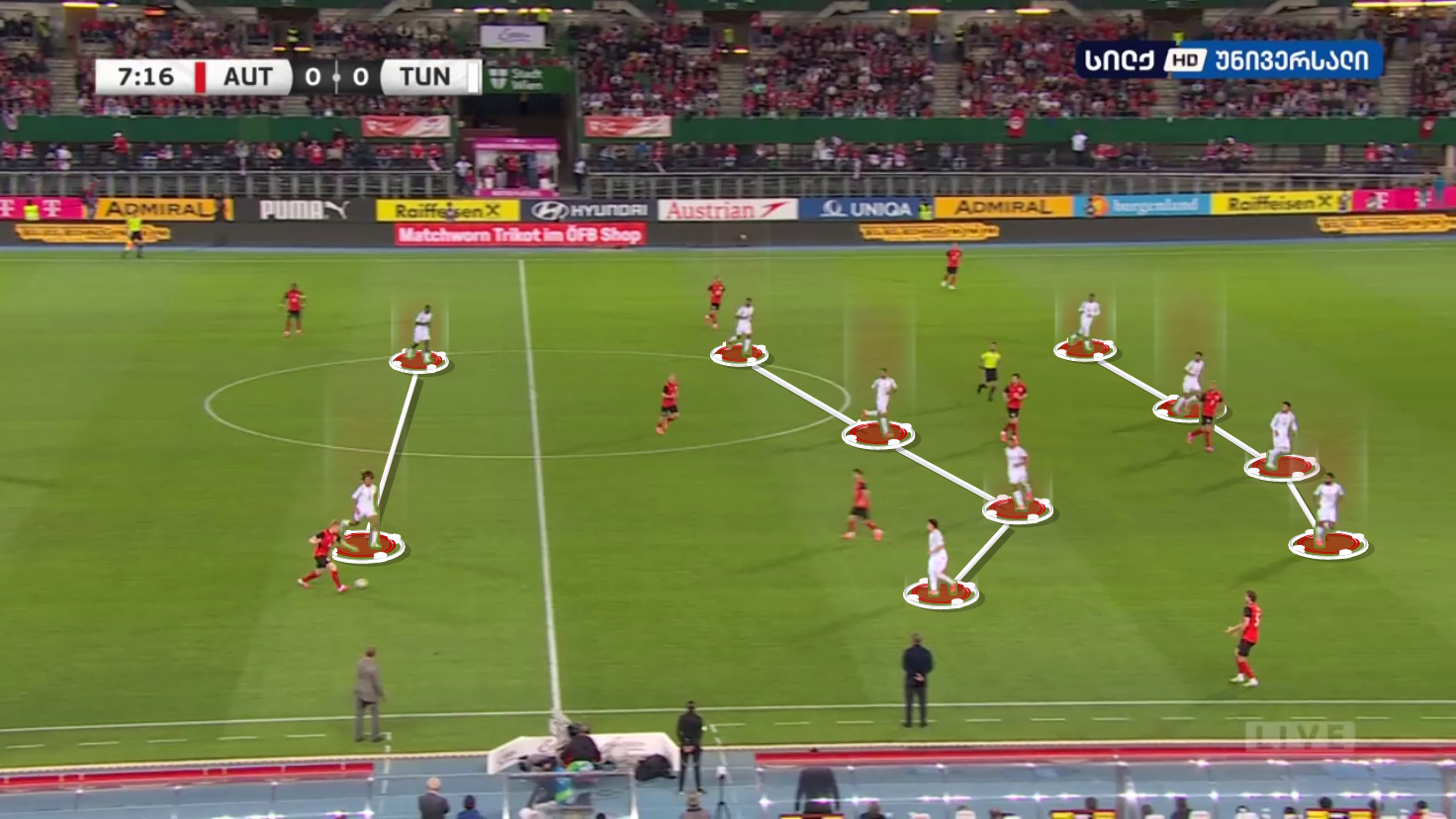
In addition to the importance of high recoveries, Tunisia will try to play with a medium defensive block and avoid retreating too much.
This would disturb the opponent’s playmaking ideas since it makes Tunisia’s lines too close to each other, while it also keeps Tunisia ready for any counterattacking possibility.
The following picture showcases Lamouchi’s 4-4-2 defending idea and how he avoids using a low block in order to alleviate Austria’s attacking threats.
Tunisia Defensive Errors
Despite the recent changes in the defensive organisation and the new methods used to reduce the risks, Tunisia still need to work harder on reducing their collective and individual marking errors ahead of the World Cup.
In particular, wrong anticipatory advancing from the wings to try making high recoveries can often lead to serious issues at the back.
The lack of communication and the absence of systematic coverage on the player who makes such anticipatory movements make it complicated to avoid conceding goals from such situations.
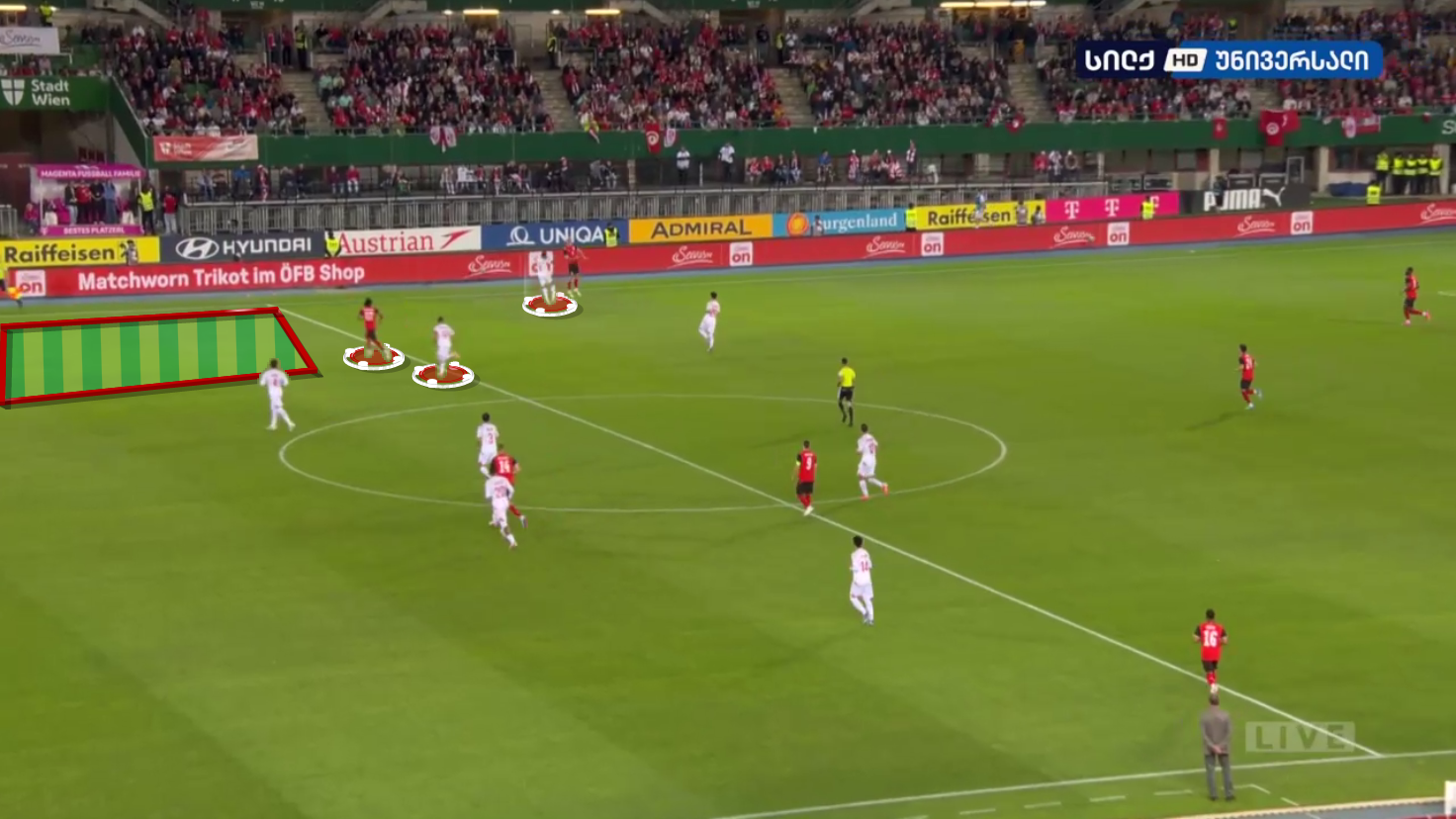
In order to limit errors like the one that led to conceding a goal against Austria, it will be crucial to avoid making such anticipatory movements unless the player is certain of getting to the ball first.
At the same time, applying systematic protective plans in such situations will be very important for Tunisia to avoid such situations against Sweden, the Netherlands, and Japan.
In this action, Abdi tried to anticipate his direct marker and left the left flank empty.
That obliged Skhiri to try saving the situation, but he was not quick enough to catch Austria’s player on time.
Tunisia Attacking Tactics & Areas For Improvement
Going forward, Tunisia will rely mainly on counterattacking and on set-piece exploitation.
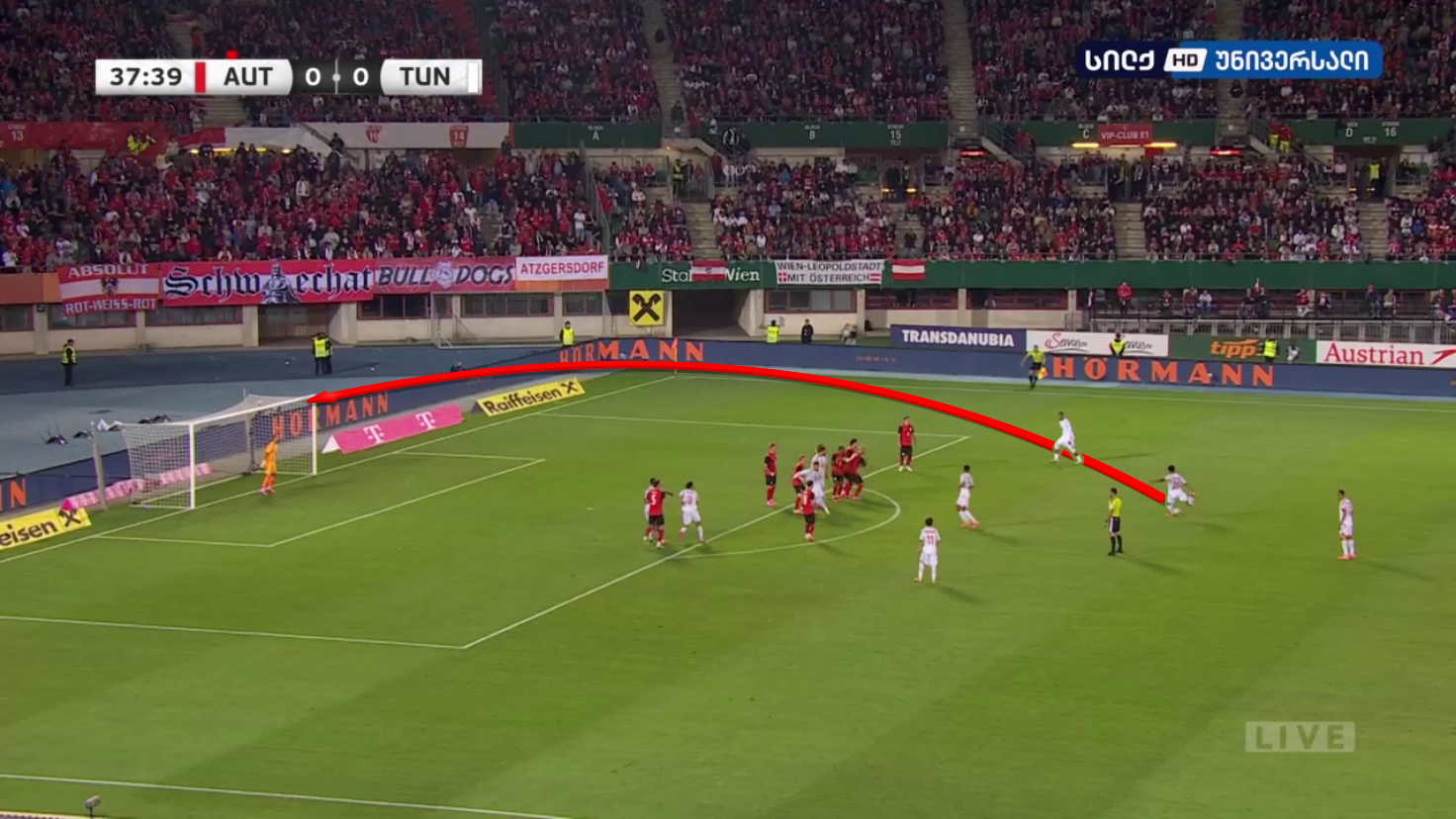
Against Austria, Tunisia were extremely dangerous on set-pieces thanks to having good enough set-piece specialists, unlike in the past.
All of Mejbri, Saad, Ben Slimane, and Ayari proved on numerous occasions that they are good enough in free-kicks and corners, and hitting the post twice against Austria from free-kicks can only confirm that.
Exploiting set-pieces in the World Cup could be a powerful weapon for Tunisia, knowing they will have to exploit opponents' marking errors and diversify their set-piece plans to force opponents to commit them.