
Elliot Anderson Scout Report At Manchester City 2026/2027: How Does He Fit Enzo Maresca Tactics? – Data Analysis
This Elliot Anderson scout report uses data and tactical analysis to examine how the England midfielder could operate under Enzo Maresca at Manchester City, including his potential roles as a left-sided No. 8, positional connector, box runner and aggressive presser.

Manchester City have turned to Enzo Maresca to lead the club into its post-Pep Guardiola era, with the Italian expected to preserve the foundations of City's positional play while introducing several tactical refinements developed during his spell at Chelsea.
One of the first major questions surrounding this new project is how Elliot Anderson will fit into Maresca's demanding midfield structure following his arrival from Nottingham Forest.
This data analysis combines event data, positional trends and heat maps from Anderson's recent seasons with Nottingham Forest and England under Thomas Tuchel tactics to identify the responsibilities that have defined his game.
By comparing those characteristics with the positional requirements of Maresca's system, our Elliot Anderson scout report projects the roles Anderson is most likely to occupy and the tactical adjustments he may be asked to make.
Enzo Maresca's Left-Sided No. 8: From Half-Space Runner To Box-Crashing Midfielder
Enzo Maresca’s Chelsea structure regularly created a 3-2-5 or 3-3-4 in possession, with an inverted full-back moving inside and both wingers holding the width to stretch the opposition.
This opened the channels between full-back and centre-back, allowing the left-sided No. 8 to attack the half-space and arrive in the box.
Enzo Fernández was particularly effective in this role, combining deeper involvement in build-up with aggressive forward movements into the left pocket before becoming an additional goal threat.
This is the profile Maresca can see in Elliot Anderson, a midfielder capable not only of connecting play, but of recognising when to leave his position, initiate an attack and then become the player who finishes it.
Anderson has already demonstrated this instinct at Nottingham Forest.
Against Newcastle United in Matchweek 36 of the 2025/2026 season, with Forest trailing 1-0, he moved towards the left half-space in the 87th minute and received the ball from Lorenzo Lucca before finding James McAtee inside the penalty area.
Anderson didn’t stop after releasing the pass; he immediately continued his movement into the box, exploiting the disruption his initial movement had created in Newcastle’s compact defensive block.
McAtee then returned the ball towards the six-yard area, where Anderson had completed his run to score the equaliser.
Elliot Anderson's Equaliser Vs Newcastle United
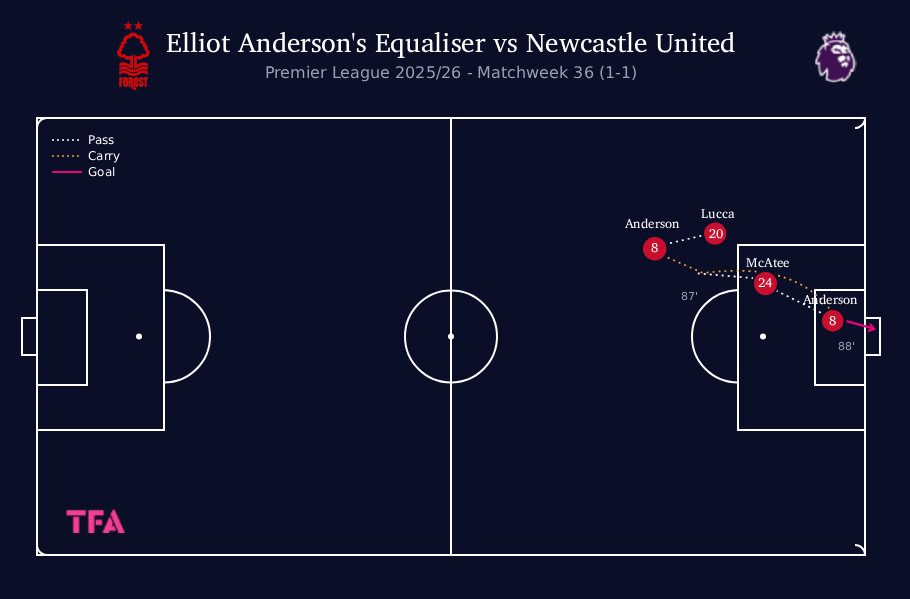
In other words, Anderson effectively provided the second assist and then finished the move himself, having initiated the entire sequence with his intelligent movement into the half-space.
That ability to manipulate a defensive structure through movement, combined with teammates and still arrive at the end of the attack could be particularly valuable at City.
With Maresca expected to use an inverted full-back and wide players maintaining width, Anderson can operate as a left-sided No. 8 who alternates between supporting circulation and attacking the space created around him.
In a midfield reshaped following Bernardo Silva’s departure and potentially Rodri’s exit, his value would therefore lie in turning positional structure into attacking momentum, starting moves, breaking defensive lines through movement and becoming the extra runner who arrives in the box to finish them.
From Forest’s Dynamic No. 8 To Enzo Maresca’s Positional Controller
Elliot Anderson’s next challenge will not simply be to reproduce the role he performed at Nottingham Forest, but to translate the same underlying qualities into a more structured positional framework under Enzo Maresca.
At Forest, Anderson operated as a dynamic left-sided No. 8, frequently carrying the ball through pressure, supporting the left flank, and aggressively counterpressing after turnovers.
With England at the 2026 FIFA World Cup, however, his movement profile demonstrated another dimension that could become particularly valuable at Manchester City.
Anderson registered 374 offers to receive, including 271 inside England’s team shape, placing him fifth in the tournament behind Jude Bellingham, Rodri, Kylian Mbappé and Pedri.
Elliot Anderson Among The Elite For Offering To Receive Inside Team Shape At The FIFA World Cup 2026
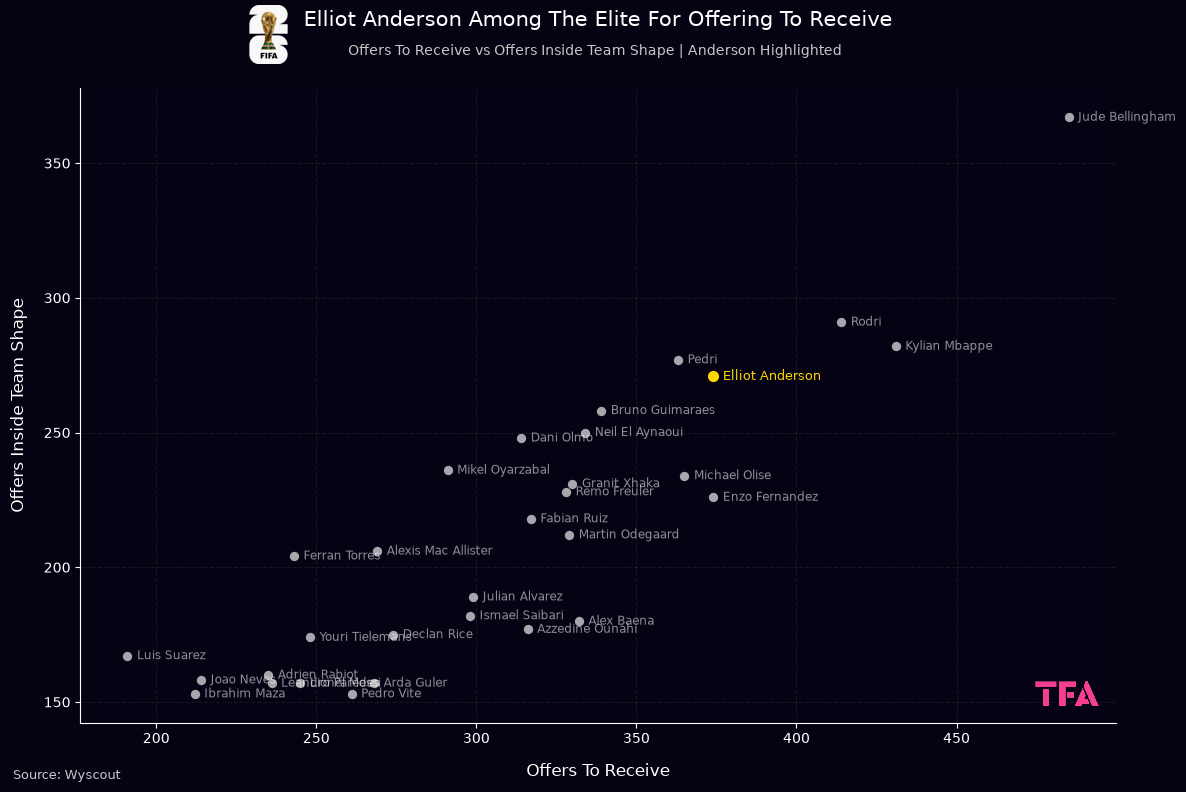
This suggests a midfielder comfortable constantly adjusting his position to remain available within the team’s structure rather than relying solely on movement beyond it.
That trait should translate naturally into Maresca’s midfield, where the No. 8s are expected to occupy and manipulate the half-spaces while the wide players maintain width.
Anderson could therefore become a positional connector who drops alongside the double pivot during build-up, moves into the left half-space when City progress higher, and then attacks the box as a late runner.
His ability to carry possession would provide another route through pressure, allowing him to break lines himself before releasing a winger or finding a third-man combination.
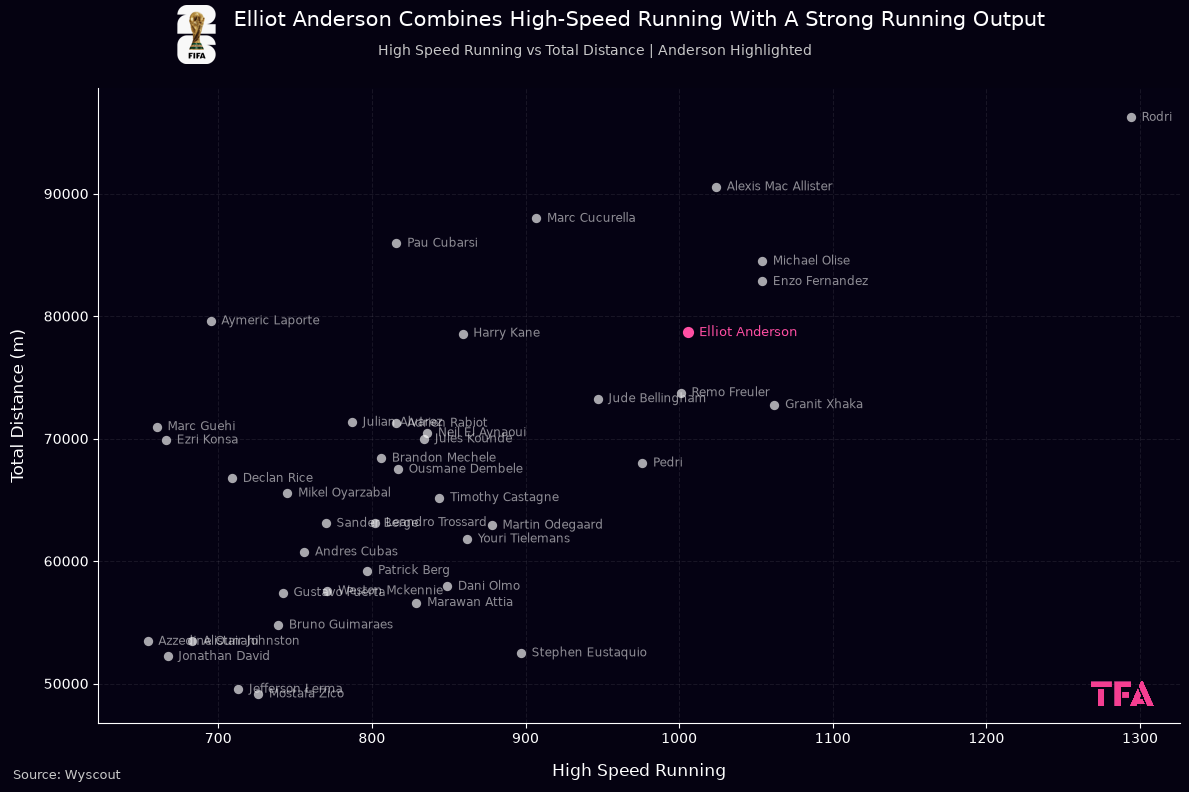
The physical demands of the role also appear well suited to him; Anderson covered 78,697 metres at the World Cup and recorded 1,006 metres of high-speed running, ranking among the competition’s most physically active midfielders in the supplied sample.
Elliot Anderson Combines High-Speed Running With A Strong Running Output At FIFA World Cup 2026