Ståle Solbakken Tactics At Norway 2026: The World Cup's Most Dangerous Underdogs? – Tactical Analysis

With their most recent participation in the World Cup dating back to the 1998 edition, Norway make their return to the 2026 World Cup with a very promising generation.
Ståle Solbakken's side have a strong chance of succeeding in this tournament; they are among the best underdogs heading into the World Cup.
In 1998, Norway reached the Round of 16 and lost against Italy after having qualified from a group stage including Brazil, Scotland, and Morocco.
This time, Norway will be facing all of France, Senegal, and Iraq in the group stage.
Norway are expected to finish second as they are more powerful than Senegal and Iraq on paper.
That said, Senegal and Iraq can create surprises in the group stage, given that they have the resources to challenge Norway and France.
At the same time, if Norway advance to the knockout phase, they have a high chance of reaching a later round in this tournament.
Norway’s style of play and remarkable discipline make them very distinguishable and complicated to beat.
In this tactical analysis, the focus will be centred on exploring Norway’s style of play, their strengths and weaknesses, and their predicted starting XI for the World Cup.
Norway Squad Depth & Predicted Starting XI
Solbakken has recently announced his squad for the World Cup, with few surprises in his player choices, apart from the absence of Eivind Helland and Aron Dønnum, even though Dønnum was competitive at Toulouse this season and also participated with Norway in the World Cup Qualifiers.
That said, the defensive section of the squad looks balanced and solid enough to ensure they concede few goals in the World Cup, despite not having stars from big teams among the defenders.
Both Kristoffer Ajer and Torbjørn Heggem have been Solbakken’s preferred options for the centre-back roles of late.
Although Leo Østigård can alternate with Heggem frequently, the Ajer-Heggem duo will still be the main defensive duo to be relied on in the World Cup.
Østigård and Henrik Falchener can be used at any time as plan B centre-backs, given that both players can deliver similar defensive performances.
Fredrik Bjørkan and David Wolfe will be competing for the left-back role, with the advantage going to Wolfe to be the starter.
The right-back role is one of Norway’s significant strengths, as Julian Ryerson has proven to be one of the most impactful assist-makers for Norway, especially this year.
For an xA of 0.34, Ryerson has an average of 0.38 assists this season.
More importantly, Ryerson’s attacking input and support inside the opponent’s half is significant and suits Solbakken’s attacking ideas perfectly.
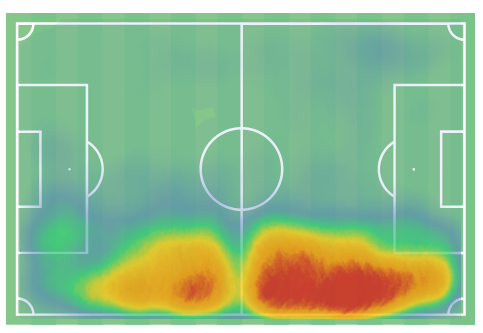
The following heat map highlights Ryerson’s tendency to advance consistently and be very useful in the attacking phase.
Julian Ryerson Heat Map 2025/2026
As a second option, Torino’s Marcus Pedersen is an underrated right-back who will not impact Norway’s attacking performance negatively if Ryerson gets injured or tired, since Pedersen proved with Norway that he is also very good with crossing and key passing.
Norway Formations
Before delving into the midfield choices, it is important to note that Norway use more than one formation on a regular basis, which directly impacts the midfield composition and player choices.
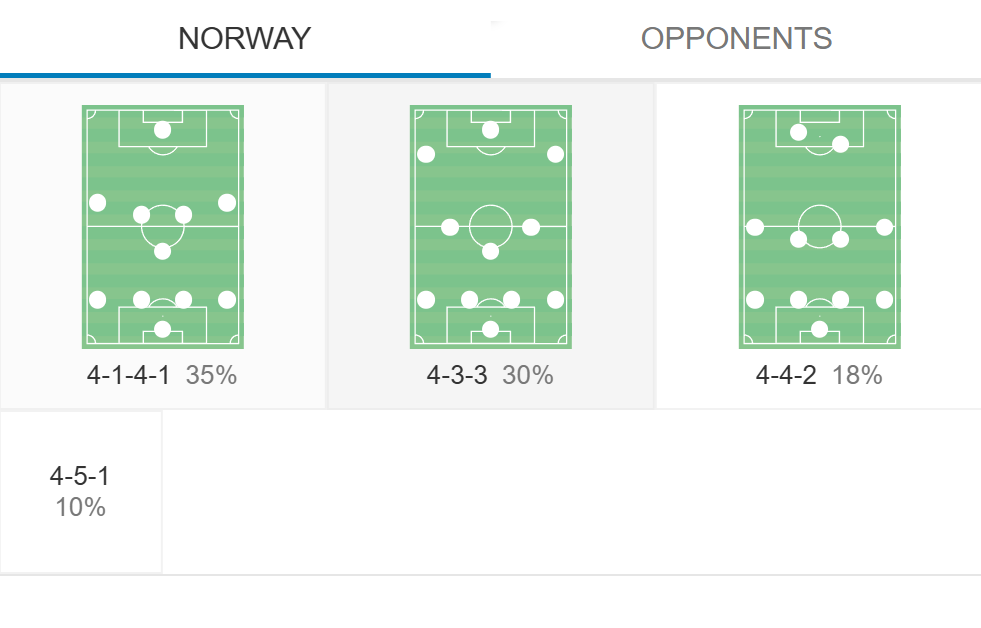
Solbakken used all 4-1-4-1, 4-3-3, 4-4-2, and 4-5-1 formations throughout this latest period, confirming that Norway’s players are used to such regular changes in formations and roles.
One of the team's qualities is their ability to interpret their evolving roles on the pitch and perform well despite the recurring changes.
That also means that Solbakken provides clear ideas and does not overcomplicate his tactics.
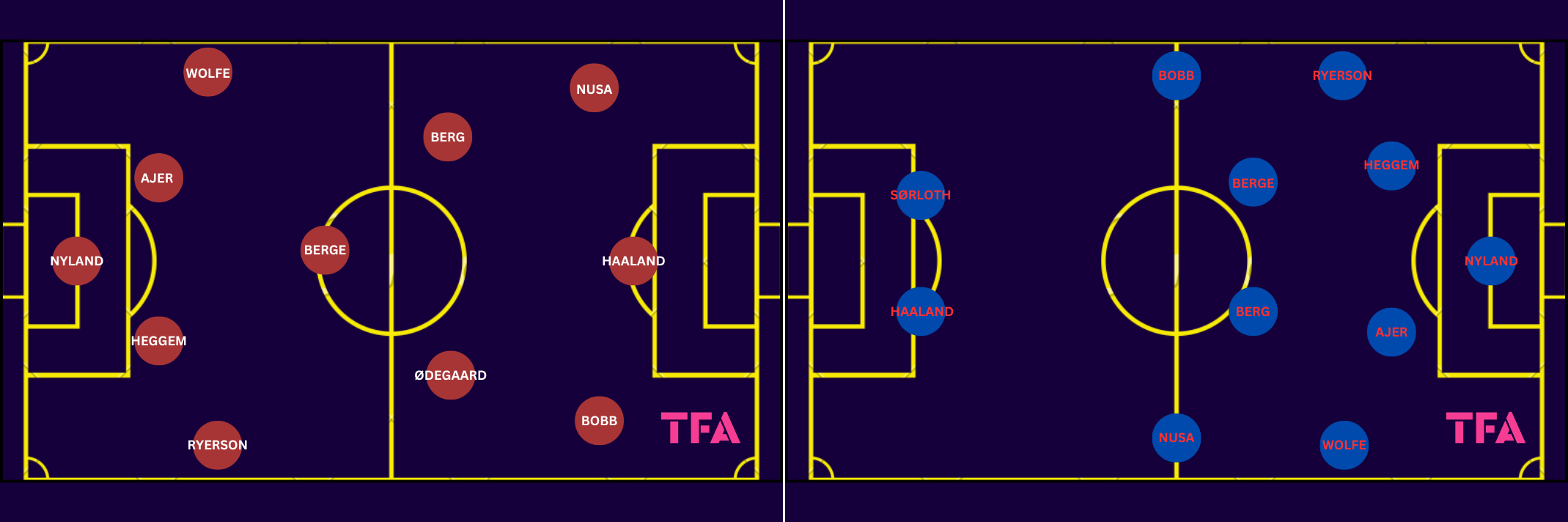
For the midfield, Solbakken will rely mainly on Patrick Berg and Sander Berge as the two confirmed starting midfielders, especially in a 4-4-2 formation.
But in case of switching to the 4-3-3 formation, Berge will be the favourite for the defensive midfielder role, with Kristian Thorstvedt and Patrick Berg having been recent selections instead of Morten Thorsby and Martin Ødegaard for the central midfielders’ roles.
That said, Ødegaard is very much in contention for a starting spot over Thorstvedt if he remains fit.
Up front, the best choices for Solbakken are obviously Erling Haaland and Alexander Sørloth as an attacking duo if he plans to use the 4-4-2 formation.
If using the 4-3-3 formation, Antonio Nusa would be the preferred left-winger, with Jens Petter Hauge as his perfect replacement, Haaland as the striker, Jørgen Strand Larsen as the backup striker, and either Oscar Bobb or Sørloth as the right-winger.
The formation graphic below shows two of the best possible formations and lineups for Norway in the World Cup, as both formations suit Norway’s playing style well.
Norway Attacking Strengths
What makes Norway a potential dark horse in the World Cup is their ability to score goals with ease against any team, and that team quality confirms that Norway can be extremely difficult to defend against.
What is even more impressive is that their attacking plans do not rely solely on Haaland's individual abilities but rather on collective combinations and the involvement of most of the attacking/midfield players.
This helps keep Norway unpredictable even when Haaland gets tightly marked.
In fact, Haaland is the star player on the team.
But several other players have the individual skills needed to shine and be crucial in terms of goalscoring and assist-making.
Nusa is one of those underrated Norwegian players who can make the difference from anywhere, using both feet efficiently.
The best proof for this is his outstanding left-footed goal against Italy in the World Cup Qualifiers.
The same applies to Bobb, an underrated left winger capable of penetrating with pacy acceleration and very useful in playmaking and off-ball movement in the final third.
In fact, Bobb and Nusa are very useful assets to Norway’s attacking plans, which usually involve a lot of off-the-ball movement, positional changes during attacks, and quick passing to confuse opposing defences.
The quick passing exchanges and off-the-ball movement, as well as the great chemistry between the players, are what make the team very unpredictable in attack.
The following goal example highlights the impact of these quick exchanges and reliance on movements out of position and in half-spaces to break opposing defences.
Bobb moved centrally in this action against Italy, getting closer to Nusa, who was agile and intelligent enough to get away from his markers and provide a pass to Bobb.
Bobb positioned himself in the perfect spot to receive that pass inside the box and notice Haaland’s very intelligent positioning behind all of Italy’s defenders.
That helped Haaland avoid all sorts of marking and surprise them by receiving the cross and volleying it, leaving neither the defenders nor the goalkeeper a chance to block or save it.
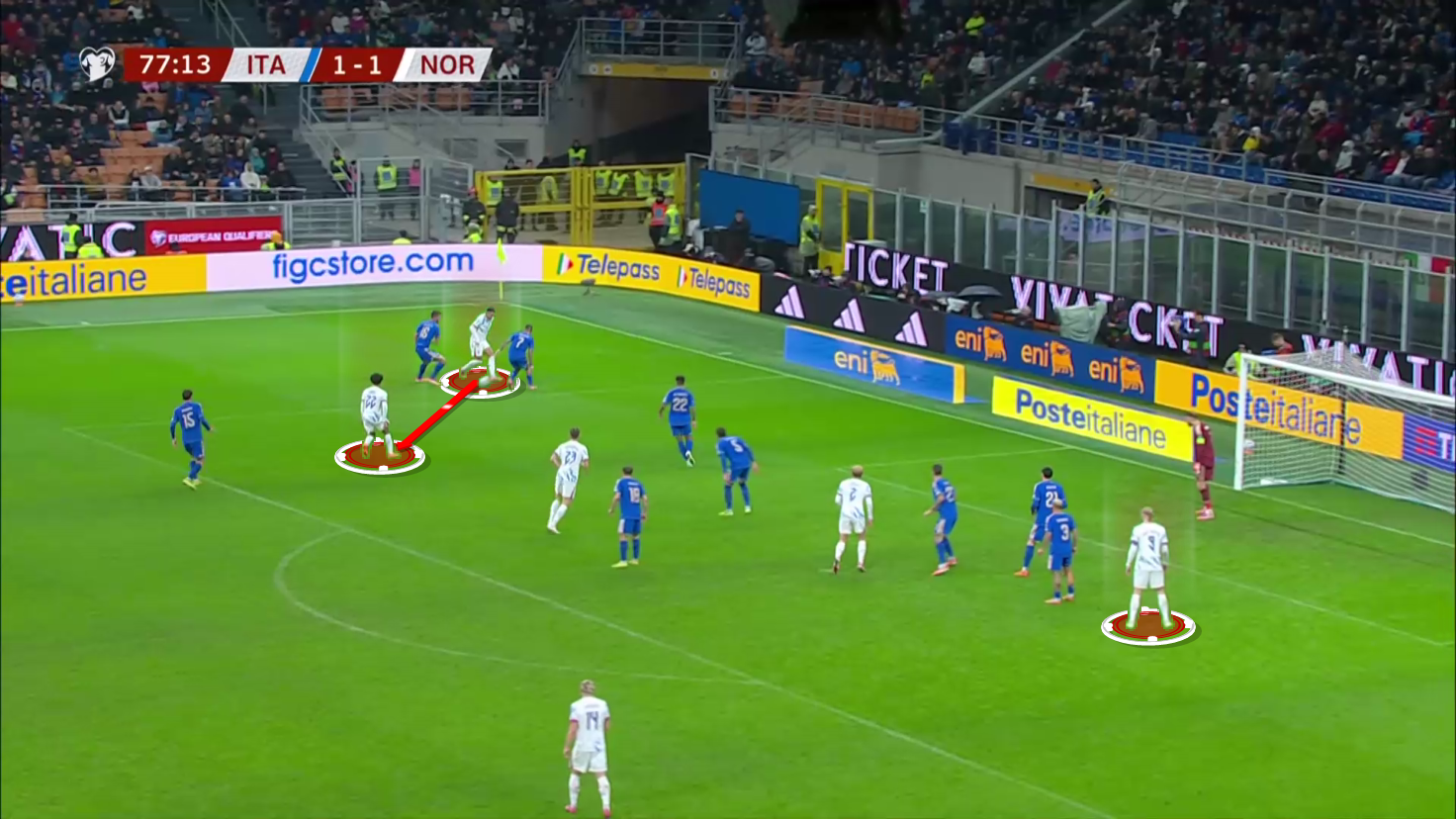
This kind of action, which requires significant understanding among the attacking players and intelligent off-the-ball movement from all of them, was relied upon to find the back of the net.
Norway Aerial Weapons
Another huge attacking asset that Norway will be relying on, and one of the team’s main attacking solutions, is crossing to both Haaland and Sørloth.
With both strikers having high averages in winning aerial duels, this solution can be very rewarding in the World Cup, given that both players are very difficult to defend against in the air.
Haaland wins 3.27 aerial duels per match, and Sørloth wins 8.14 per game, with both players considered among the best at scoring headers.
This solution should not be underestimated or considered as a normal solution, mainly because Norway’s crosses are usually very accurate and dangerous.
In other words, Norway rarely crosses inaccurately, as they provide passes to the final third with 80.8% accuracy and progressive passes with 76.3% accuracy.
These high passing averages can only confirm that Norway play progressive attacking football that, at the same time, relies on off-the-ball movement, agile penetrations, consistent, accurate crossing, and powerful shooting from distance.
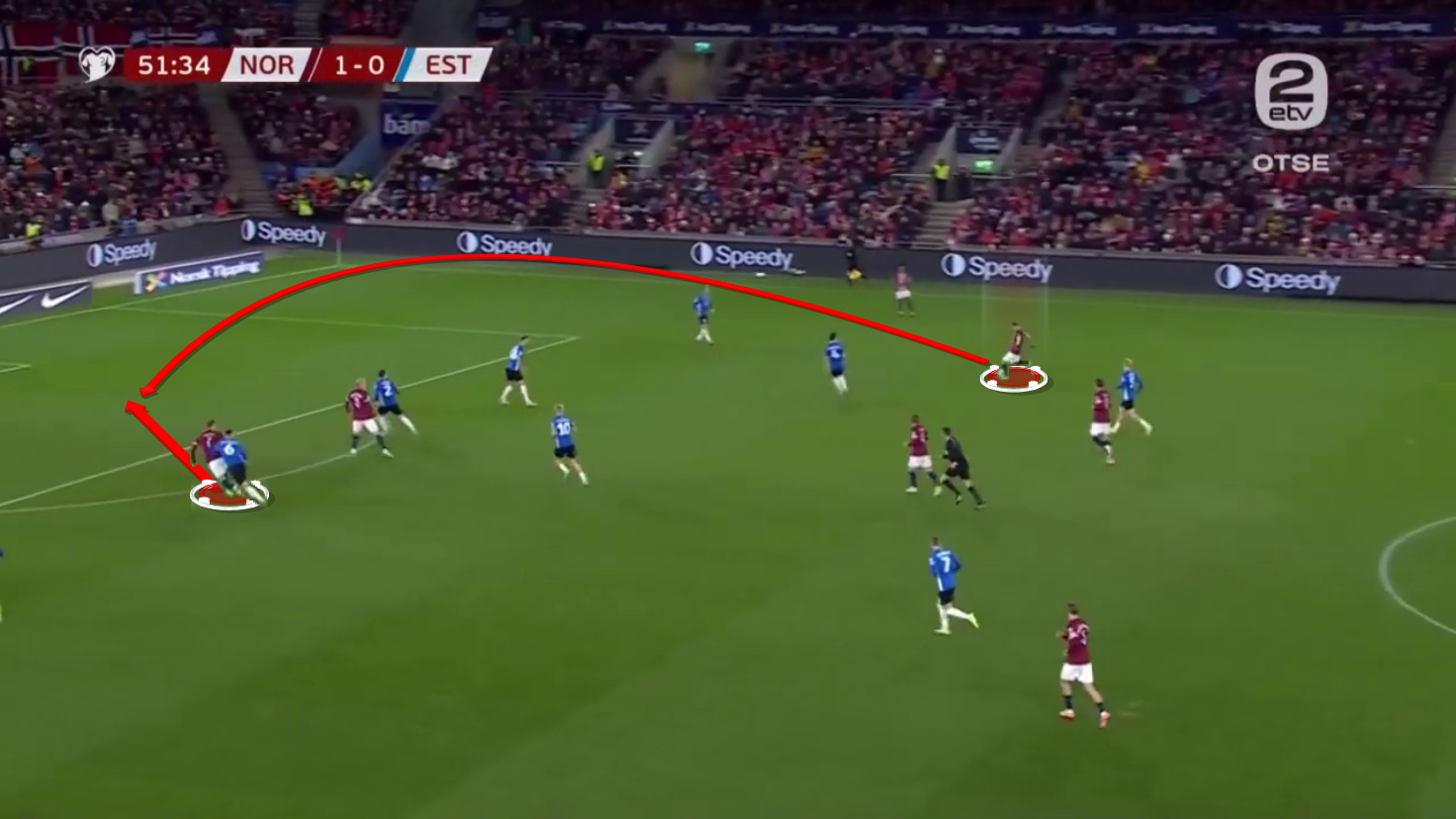
The following example showcases one of the many Norway attacking solutions from the wings.
Norway relies heavily on different types of crossings, including early crossings like the one in this picture.
Norway have players who can be crucial when receiving such crosses, and early crosses in particular give them an advantage over defenders, as they often anticipate the cross and surprise defenders, as Sørloth did in this action.
Norway Progressive Passing
Solbakken is a head coach who relies heavily on progressive passing and vertical football, as he values this style of play and uses it extensively with Norway.
This style has become a trademark of Norway lately, with the team succeeding in playing very quick, vertical football and finding progressive passing solutions in a fast and fascinating way, mainly thanks to intelligent off-the-ball movement and the understanding that has developed among the players.
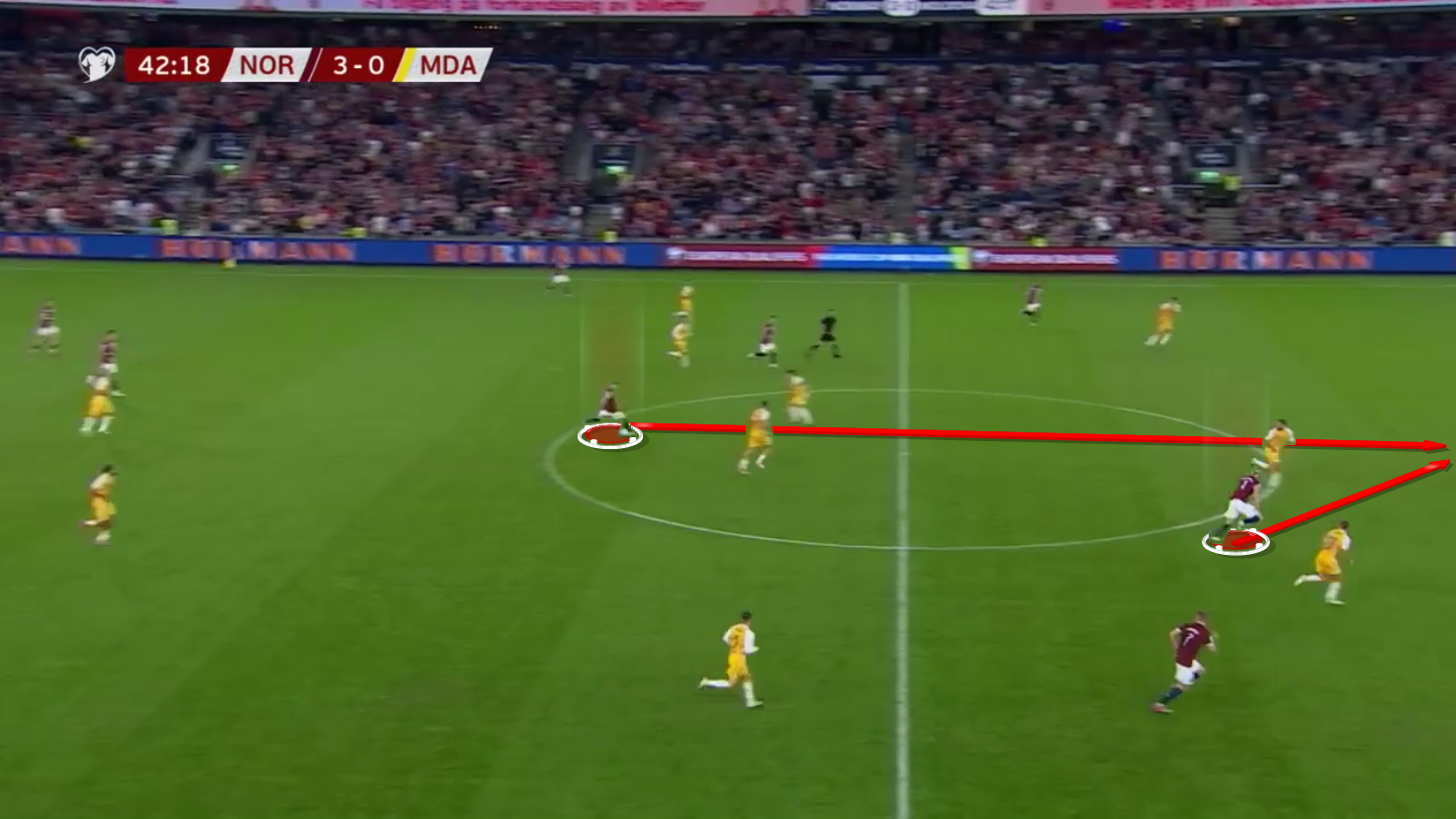
Numerous actions and matches confirm the efficient execution of these ideas, and perhaps one of the actions that highlight it in an obvious way is Haaland’s fourth goal against Moldova.
In this action, Norway advanced quickly to reach midfield, and with Haaland moving well towards the back of Moldova’s defensive line, Larsen did not hesitate before providing a vertical key pass towards Haaland’s run.
In fact, Norway reached Moldova’s goal with only two passes and a shot, illustrating how easily this team can attack.
Norway Defensive Weaknesses
What deserves much more attention from Norway is their moments of confusion in the defensive phase, especially when conceding on counterattacks.
Even though Norway is not a team that concedes a lot per match, they tend to suffer more against teams that master quick counterattacking and have powerful attacking players for doing so.