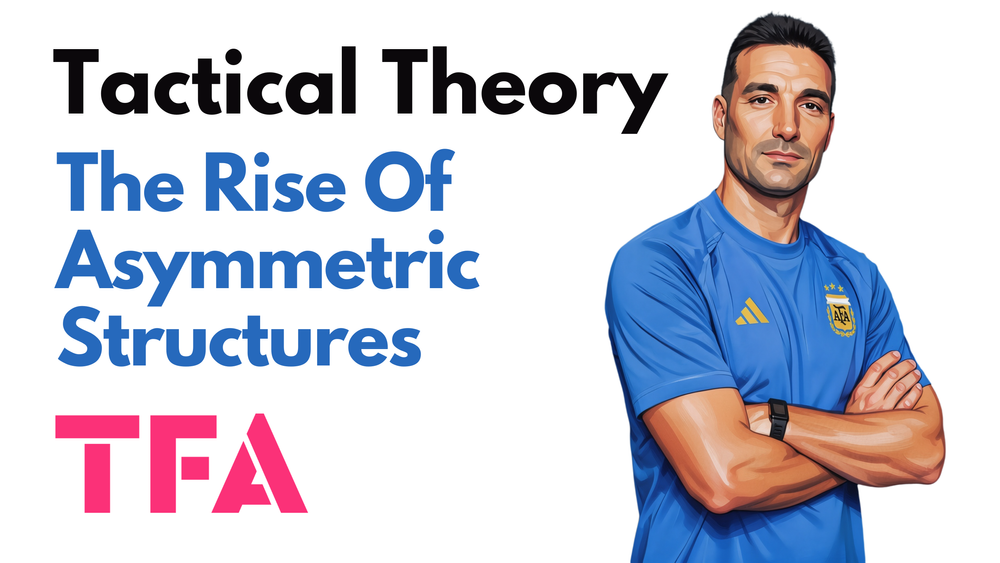
The Rise Of Asymmetric Structures To Challenge Positional Play In Top-Level Football - Tactical Theory
The 2026 FIFA World Cup showcased a growing tactical counter-trend to rigid Positional Play. We examine how Argentina, Colombia and the United States used relational football, asymmetric overloads and playing around the ball to create numerical, qualitative and socio-affective superiorities.

International football has been shaped for over a decade by the omnipresent influence of Positional Play.
This doctrine, having become the dominant paradigm of top-level football, has established as dogma the rational, symmetrical, and disciplined occupation of the different zones of the pitch.
Under its traditional commandments, advantage is conceived as a purely geometric product: players must inhabit predetermined quadrants, pin their opponents in the outer or inner channels, and maintain appropriate relational distances, subjecting themselves to an inflexible maxim that has guided generations of managers: "wait for the ball in your zone, do not go looking for it".
However, the 2026 FIFA World Cup has served as the stage for the emergence of a fascinating counter-trend.
Far from submitting to the rigidity of the spatial map, several top-tier national teams, with proposals as diverse in their roots as Argentina, Morocco, the United States, and Colombia, have openly challenged the status quo.
These teams have reintroduced and refined anti-positional and relational elements, betting on a premise as ancient as it is revolutionary: playing around the ball.
By prioritising the crowding of players around the ball over the uniform distribution across channels, these teams have shifted the conceptual axis of advantage.
Our tactical theory examines this counter-trend where it is no longer about taking ownership of coordinates through spatial dominance, but about overcoming the opponent through temporal dominance via deliberate overloads and asymmetries.
From Spatial Dominance To Temporal Dominance
To understand the systemic significance of this evolution, it is essential to analyse the paradigm shift in the management of space and time.
Dogmatic Positional Play starts from space to arrive in time: the correct occupation of zones guarantees that, when the ball reaches the free man between the lines, he has the extra second required to execute the subsequent action.
Conversely, anti-positional and relational approaches invert the equation: they start from time (the tempo and pass density around the ball) to create space.
By unconcernedly setting aside the symmetrical occupation of channels, the attacking team allows its most creative pieces to abandon their theoretical positions to approach the focal point of the play.
This produces a process of oversizing or asymmetric overload on a single side of the pitch.
This crowding of shirts on the strong side acts as an unpredictable gravitational magnet for the opponent's defensive block.
Faced with the density of receivers and the accumulation of short passes, the opposing defensive structure is forced to compress, shift massively, and break its usual coverage distances.
Space, therefore, ceases to be a static zone inhabited passively; it becomes a dynamic consequence that is created and destroyed through the ball's power of attraction.
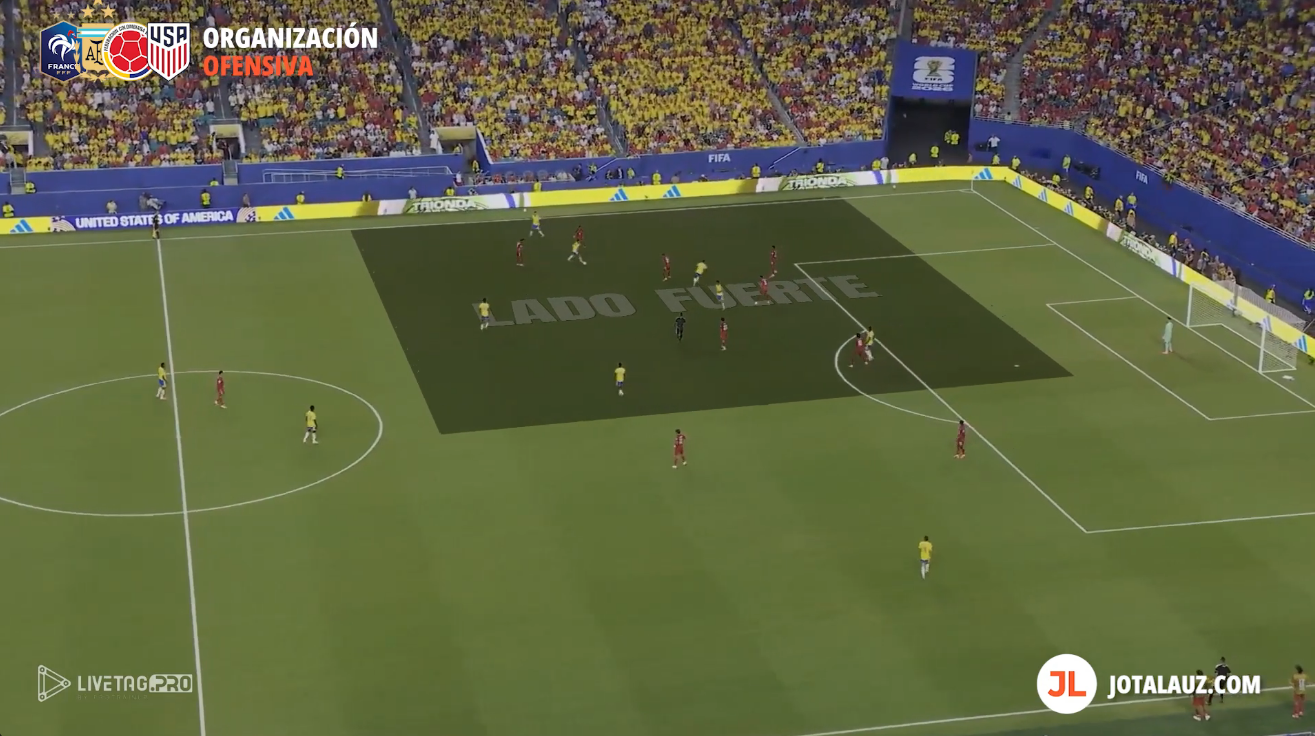
From this perspective, asymmetry ceases to be a defensive imbalance and transforms into the system's offensive engine.
By renouncing traditional geometric balance, the team that plays around the ball takes absolute control over the tempo of the match, manipulating circulation speed and unilaterally deciding when to compress play into a square metre and when to accelerate into depth.
The Three Superiorities On The Strong Side
The intentional creation of a strong side through anti-positional overloads does not constitute an anarchic or fortuitous chaos; it responds to a meticulous tactical plan aimed at generating three interconnected types of superiority within the offensive ecosystem:
- Numerical superiority and transition protection: By allowing players from different transversal channels to cross the pitch to approach the ball-carrier, the attacking team guarantees a superior density of personnel in the ball area relative to the number of opposing defenders.
This accumulation of pieces not only ensures multiple short passing options to progress under pressure, but also immediately strengthens counterpressing.
If the ball is lost in an area with a high density of own shirts, the counterpress is immediate and suffocating, preventing the opponent from launching a counterattack. - Qualitative superiority on the weak side: This is the direct and collateral benefit of the overload.
While the attacking team draws the opponent's attention, resources, and defensive shifts toward the strong side, the opposite side (the weak side) progressively depopulates.
By exiting the high-density zone through a sequence of attraction passes and executing a clean switch of play to the neglected flank, the team finds an ideal 1v1 or 2v2 scenario in open space, where a game-changing attacker or an overlapping full-back can exploit their biomechanical advantage with time and space. - Socio-Affective Superiority & Intuitive Synchronisation: This is the richest conceptual dimension of relational football.
Positional freedom to approach the play reduces the physical distances between the players with the highest technical sensitivity, enhancing natural affinities and tacit understanding among them.
The creation of micro-societies allows for the constant appearance of one-twos, one-touch layoffs, feints, dummies, and improvised positional exchanges.
The play does not respond to a pattern predetermined by the coach, but rather to the shared and intuitive interpretation of the players at the exact moment they interact with the ball.
Methodological Duality
Throughout the World Cup, we witnessed not the uniform application of a single anti-positional formula, but rather the coexistence of two clearly differentiated methodological approaches:
- Positional models with anti-positional insertions: This corresponds to national teams whose structural matrix still belongs to Positional Play, maintaining positional discipline, pinning opposition markers, and the rational distribution of zones as a general rule.
However, to avoid falling into flat or predictable circulation against low blocks, their coaches have introduced specific anti-positional mechanisms within the structure.
These are long compensatory movements or bounded freedoms (such as a central midfielder crossing the pitch horizontally) to generate isolated superiorities on the strong side without dismantling the team's safety net. - Relational models empowered by chaos: At the opposite extreme emerge teams where positional play is the governing principle and the raison d'être of the game model.
For these teams, rigid spatial occupation is perceived as a straitjacket that stifles individual talent.
Asymmetries and absolute freedom to travel around the ball are essential.
The system does not seek to organise the players on the pitch, but rather to allow the players to organise the game through their interactions with the ball, finding their greatest competitive strength in unpredictability and apparent chaos.