Vladimir Petković Tactics At Algeria 2026: Built To Challenge Argentina & Austria In World Cup Group J? – Tactical Analysis

Algeria will participate in the FIFA World Cup for the fifth time in 2026.
The main objective for the African nation will be to reach the Round of 16, as they did in their historic 2014 World Cup run.
That year, the Fennecs finished second in Group H, beating South Korea, drawing with Russia, and losing to Belgium.
Moreover, Algeria delivered an outstanding and historic performance against that year's title winners, Germany, forcing them into extra time.
This time around, Algeria's mission looks a bit more complicated in the group stage, given the more powerful teams in their group.
Playing against Argentina, Jordan, and Austria will put Algeria in a very tricky situation.
A lot of focus is being placed on the first game against Argentina, but the complexity of the matches against Austria and Jordan can't be overlooked.
Austria have proven in recent years that they can beat anyone.
With that in mind, it will be crucial for Algeria to give that match as much importance as they give to the Argentina clash.
Facing Jordan should be an opportunity for Algeria to get three points.
However, if they underestimate their opponent, it could be negative for Algeria, as Jordan are also putting most of their hopes on getting points from the Algeria game.
In the latest FIFA Arab Cup, Jordan reached the Final and beat all the teams they faced, including Egypt, Saudi Arabia, and Iraq.
Therefore, it will also be important for Algeria to prepare well enough to secure the points in this match.
In this tactical analysis article on Vladimir Petković's Algeria, we will explore the team’s characteristics and style of play in depth, focusing on their strengths and areas for improvement ahead of the 2026 World Cup.
Our World Cup tactical analysis will also examine the expected best starting Algeria lineup and the Algeria formation Petković is most likely to rely on during the tournament.
Algerie Squad Depth, Predicted Starting XI, & Formations
The current generation of Algerian players can be considered one of the most powerful they've ever had.
Petković has made a convincing set of player choices while excluding some powerful players like Youcef Atal, Mehdi Dorval, Ismaël Bennacer, Baghdad Bounedjah, Youcef Belaïli, Monsef Bakrar, Adam Ounas, and more.
Petković cannot really be blamed for keeping these players out, mainly because the squad he called up for the World Cup is already full of strong players at every position.
So, in terms of squad depth and the need for consistent quality during the World Cup, Algeria should not worry.
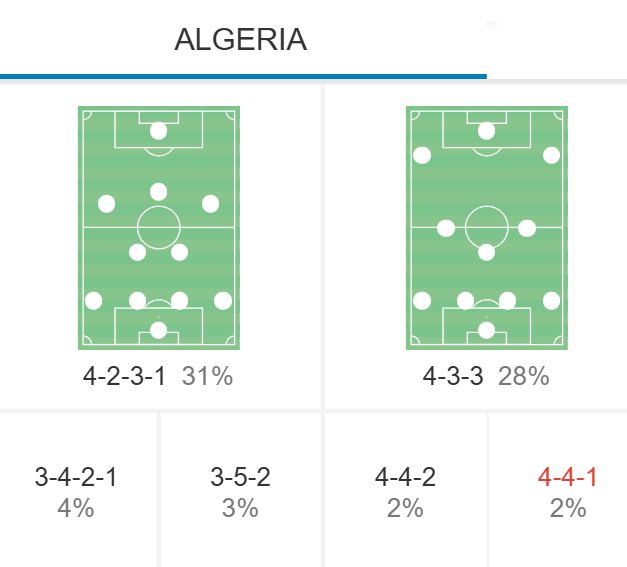
For the possible tactical plans and formations that Petković is going to use during the World Cup, he is more likely going to alternate between 3-4-2-1 formation, 4-2-3-1 formation and 4-3-3 formation.
Algeria used to play 4-2-3-1 most of the time, especially on big occasions, while using 4-3-3 when they needed to secure their midfield with more players in that line to be more balanced at the back.
In the last period, however, Petković started experimenting with the 3-4-2-1 formation and used it twice.
Using that formation in preparatory games suggests that Petković is seriously considering it for the World Cup, most likely against Argentina or Austria at least.
Relying on the 3-4-2-1 would guarantee more defensive compactness and less space for the opponent if used effectively.
Therefore, Petković is more likely to use that plan to limit his opponents’ attacking strength and counter with counterattacks.
It is expected to see Petković change the formation more than once during the group stage, given that he called up players who can help him switch between these formations without compromising quality.
Algeria Squad Depth
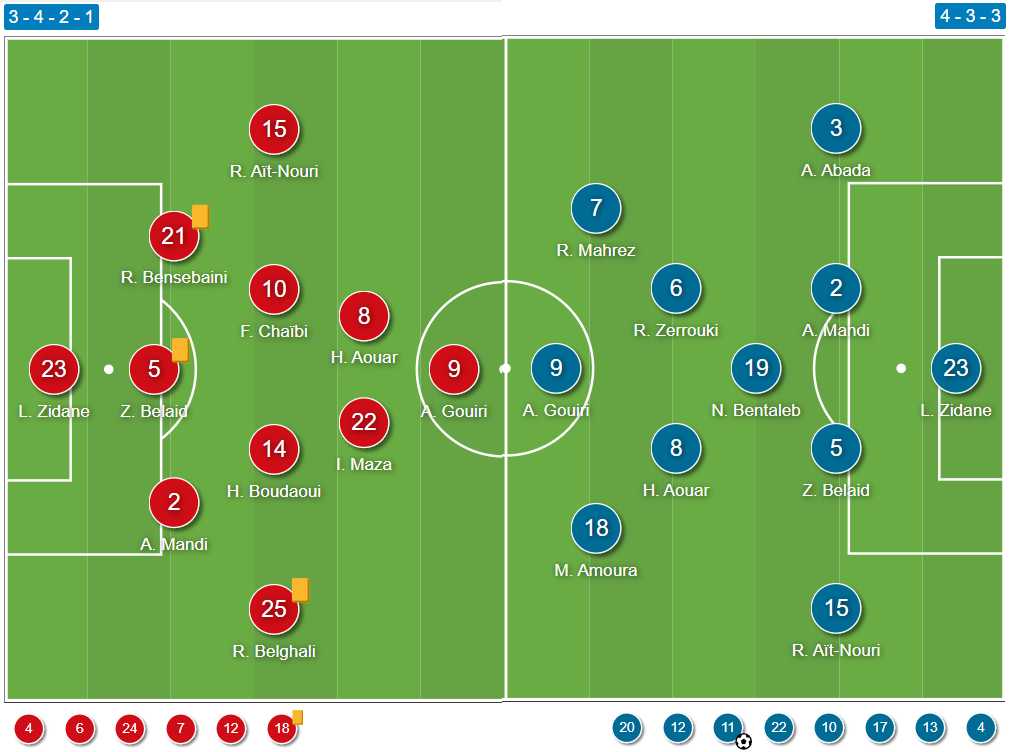
The names used in the following two lineups, taken from Algeria’s last two games, do not represent Algeria’s best possible lineup.
There were injuries and positional changes that led Petković to rely on plan B players in some positions during these two games.
That said, the graphic was intended to highlight Algeria's squad depth and how it enables Petković to switch between formations without necessarily resorting to players out of position.
In other words, players like Achref Abada and Samir Chergui are, at the same time, backup centre-backs and can play as right wing-backs with ease without compromising their quality.
Calling up players like these two defenders helped Petković a lot in achieving the desired tactical fluidity through formation changes.
The same applies to Ramy Bensebaini, who is the first-choice left centre-back but who can also do very well as a left wing-back in case Rayan Aït-Nouri is injured or tired.
This idea is also applicable in midfield and in attack, as the picture shows Houssem Aouar having played as a central midfielder in a match and as a left winger in another.
The same is valid for Mohamed Amoura and Amine Gouiri, who can play well both as main strikers or as left wingers.
The ability of several players on this team to play in more than one position without compromising their quality will be very helpful to Petković for in-game changes in formations or roles.
Best Possible Algeria Lineup
The best possible Algeria lineup will mostly depend on the chosen formation.
If Petković is going to rely on the 4-2-3-1 formation, the first-choice goalkeeper is definitely going to be Luca Zidane, with Oussama Benbot as the second option.
The defensive duo will be made up of Ramy Bensebaini and Aïssa Mandi, with Zineddine Belaïd being the third defender in case Petković chooses to go for the 3-4-2-1 formation.
All of Mohamed Abada, Chergui and Mohamed Amine Tougai will be backup centre-backs.
For full-backs, Rafik Belghali will be the first-choice right-back, with Abada and Chergui as backup options too.
As a left-back, Aït-Nouri is obviously the first-choice, with Jaouen Hadjam and Bensebaini as backup options.
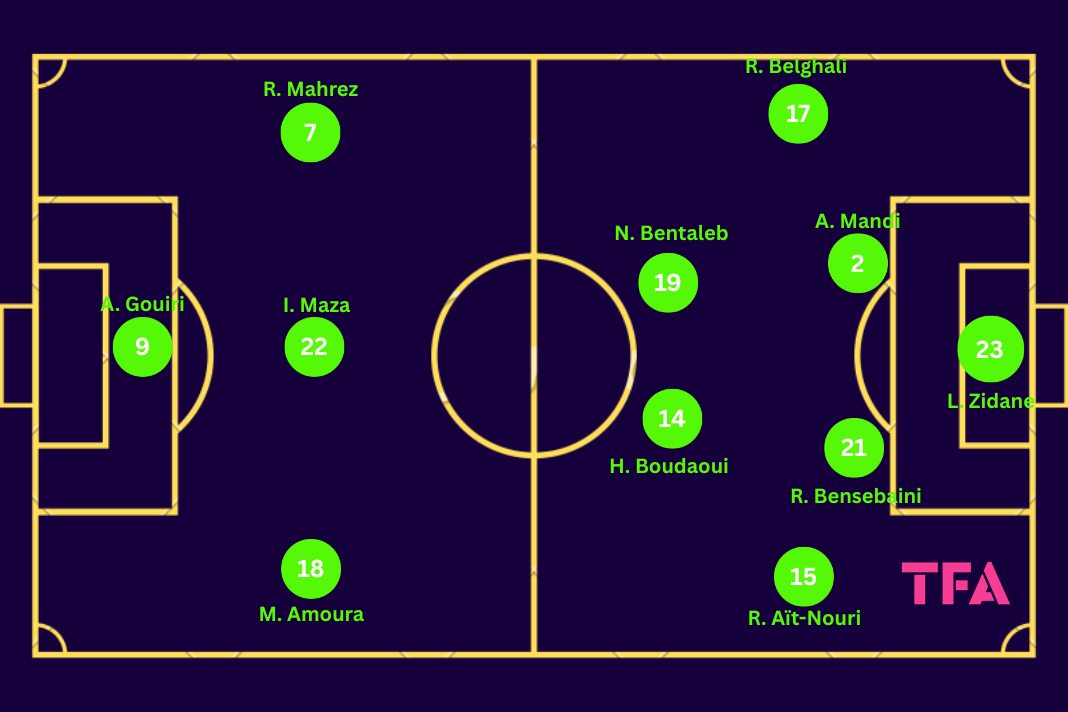
The midfield duo will most likely be made up of Nabil Bentaleb and Hicham Boudaoui plus Ibrahim Maza or Farès Chaïbi as advanced playmakers.
At the same time, there are a few other good options for the midfield duo, such as Bentaleb + Aouar, Boudaoui + Aouar, Ramiz Zerrouki + Bentaleb, and Zerrouki + Boudaoui.
The midfield positions are among Algeria’s remarkable strengths, as Petković can make many changes in these positions without necessarily affecting performance.
In attack, Riyad Mahrez represents the most powerful option on the right wing, with Anis Hadj Moussa being a very solid replacement to him, and Farès Ghedjemis being the third option.
On the left wing, Petković is more likely to rely on Mohamed Amoura as a first-choice left winger, with Adil Boulbina and Amine Gouiri as backup options.
The slightly problematic role for Petković’s side is the striker position, especially following the exclusion of the experienced Baghdad Bounedjah, who was the first-choice striker.
This exclusion leaves Petković with little time to experiment with and confirm another striker as the starter, with both Gouiri and Nadhir Benbouali good enough for the role but lacking the consistency and chemistry needed with their teammates at the national team level.
If Petković uses the 3-4-2-1 formation, the midfield will most likely consist of Bentaleb and Maza, with Aït-Nouri and Belghali as wing-backs and both Mahrez and Amoura as wingers.
Algeria Attacking Strengths
Algeria’s attacking ideas and strengths rely heavily on the wingers and on advancing down the wings to create threats, whether in open play, in possession-based plans, or in counterattacks.
With their very dangerous wingers, Algeria have usually been able to make the difference from those areas, as these wingers are very good in 1v1 duels and cutting inside when needed.
This advantage that Algeria often has on the wings leads to goals, whether through solo efforts or by providing assists to the striker inside the box.
Algeria showed on many occasions this year that they can create numerical superiority on the wings thanks to the players’ 1v1 dribbling ability and the overlaps of the advancing right-back/right wing-back.
This can always be a powerful plan for Algeria to reach the box, even against strong defences.
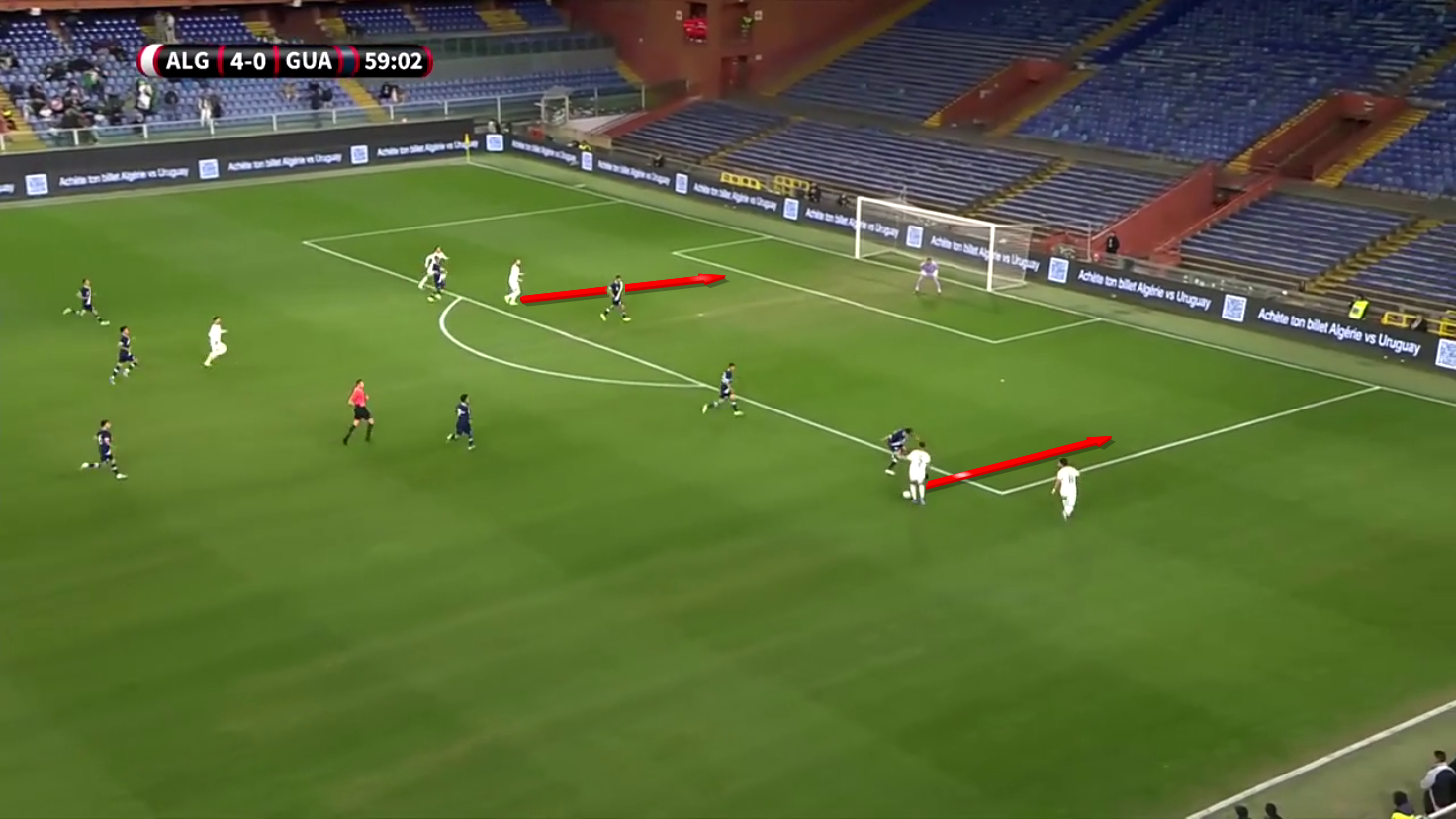
In this action, Algeria score a goal with ease thanks to a quick switch of play that puts Mahrez in a favourable situation mainly thanks to the support he had from his teammate.
The overlap made Mahrez’s job easier as he only had to fix his direct opponent and provide a through pass to his teammate.
At the same time, the correct movements without the ball of the striker Gouiri highlight the understanding that this is being created between these players, as Gouiri moved in time to meet the pass at the right time and spot before scoring.
Right-Wing Powerful Options & Solutions
It is important to stress Algeria's right-wing options and their impact on Algeria’s attacking plans, as Petković’s plans rely heavily on the right-wing for playmaking.