
4 Possession Coaching Drills To Develop Better Ball Retention Like Brendan Rodgers - Tactical Theory

Possession exercises are a well-used tool for coaches and are common in training sessions at all levels of the game.
Increasingly, these football training exercises replicate real game scenarios rather than generic setups and rules designed primarily to work on the technical elements of keeping possession.
By adding the tactical element to possession exercises, coaches can mimic what they expect to face in the next game while still maintaining intensity; a key aim of most possession exercises.
This tactical theory will provide four possession exercises for soccer coaches to use to improve their team's ball retention and work on specific patterns of play in both attack and defence.
Two Zone Defensive Possession
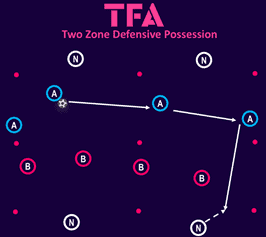
This simple possession exercise is designed primarily for coaches to work on bedding in the principles of midfield defensive shape.
It has the additional benefits of allowing the attacking team to work on moving the ball at a speed quick enough to break down a midfield block and to time a line-breaking pass.
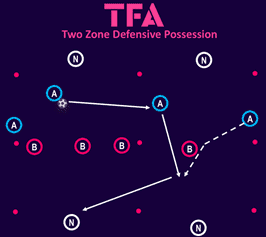
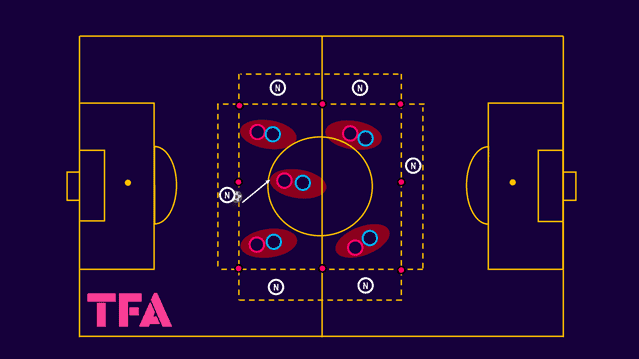
At the beginning of the practice, both teams must remain in their respective rectangular zones.
The aim of the attacking team is to work a passing opportunity into one of the neutral players positioned behind the defending team on the edge of the area.
Teams are awarded points every time they find the neutral players (white in the above image).
When the neutral player receives a pass, they put the ball back into play, but for the opposite team.
The team that just scored the point must reorganise themselves quickly into their defensive shape before the now attacking team can pass through them.
This replicates a transition in the game, and both teams must react fast to take advantage of the opposition being off-balanced.
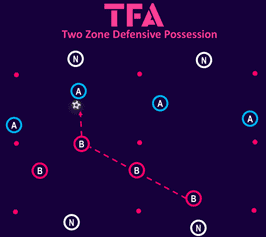
The defending team should be encouraged to adopt a diagonal line, similar to when playing in a mid-block, to prevent passes being played between them whilst still covering enough of the width of the area.
The drill can be progressed to the defending team being able to “invade” the other box.
This should be done systematically, with the defending players pressing from their shape and waiting for a certain pressing trigger, such as a bad first touch, before entering the box.
Once the nearest defending player jumps to the ball, their teammates should follow and ‘squeeze” the play.
If the defenders are working on backline defending, using the same set-up and progressions, they can be instructed not to retreat into the box behind them.
This would represent a backline defending the edge of their 18-yard box.
This also replicates the challenges the in-possession team would face when attacking the box from a central area.
The rules can be adapted to allow the attacking team to enter the box to receive a slipped-in pass and award bonus points if they are successful.
With this condition and “offside” in effect, attackers can work on the timing of their runs without the risk of being penalised.
Coaches can also allow the attacking team to dribble over the line before playing a pass into the neutrals.
Directional Possession
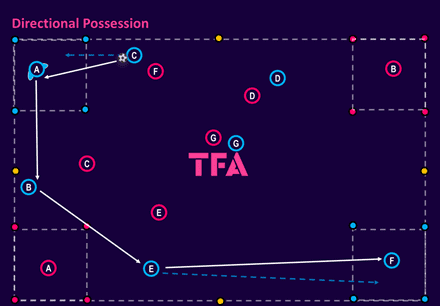
This directional possession exercise is designed for teams to work on maintaining possession while playing with a purpose, having a clear target to aim for.
Both teams, which can consist of five to eight players, have two players in boxes diagonally opposite each other.
The aim is for the in-possession team to work the ball to one of these players to score a point before finding the player in the opposite box.
When the ball is passed into the box, the receiving player is then replaced by the player who passed them the ball.
The team should be encouraged to play to the opposite side as quickly as possible while the defenders try to regain their shape and adjust to the new target.
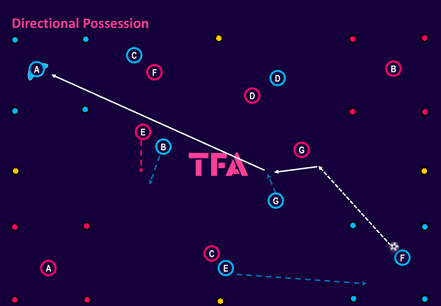
Depending on the level of player working with, coaches can implement a touch limit to speed up the play.
The box players can be exempt from the touch limit to encourage them to drive out of the boxes with the ball at their feet as fast as possible.
Coaches can choose to encourage players to dribble out of the box into the open space, perhaps preferable when working with younger players, or to run directly at an opponent.
Running directly at a defending player pins them in place, as shown above, freeing up a teammate.
The in-possession players’ teammates should make movements to open up passing lanes into the boxes.
Barcelona Rondo To Possession
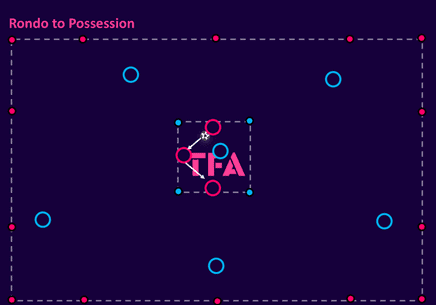
This Barcelona rondo to possession game begins in the form of a traditional rondo with a small box with a three against one.
When the defending player in the rondo box wins the ball, or the ball is miskicked outside the box, the original in-possession team (pink) become defenders.
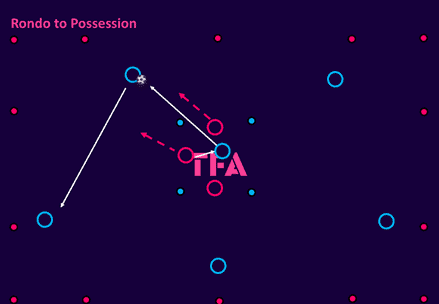
The Blue team (as shown) must then complete a certain number of passes or keep the ball for a specified length of time before the game is reset.
The Pink team players can be replaced every three rotations.
They should be reminded that the longer they keep the ball in the original box, the longer they have to rest between pressing sets.

The main purpose of this exercise is for both the in and out-of-possession teams to react quickly to transitions and the turnover of possession.
The Blue team should be aware of their teammates' positioning and ensure they are evenly spread out, then move the ball to the open space as soon as possible.
The Pinks, who are at a big numerical disadvantage, must attempt to win the ball back straight away before the Blues can get into a rhythm.
They should press as a three with the key aim of making the opposition play around them, rather than through them.
Octagon Possession
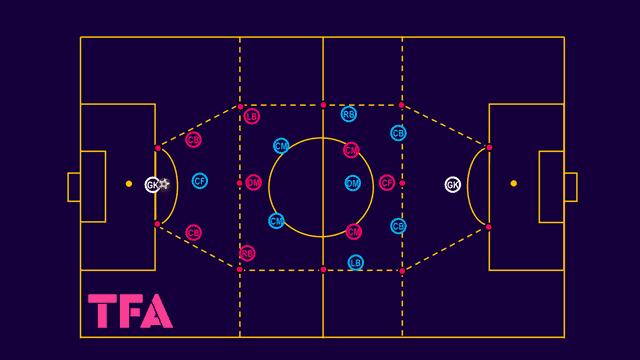
This octagon-shaped possession exercise is designed to mimic the conditions of build-up play with inverted full-backs, such as Brendan Rodgers' previous side, Celtic.
Both teams set up with eight players in a 4-3-3 without the wingers.
The pitch is divided into four zones for the team with the ball (shown in pink above).
The centre-backs occupy the first zone, and the full-backs and defensive midfielder are in the second.
The central midfielders and striker are in the third zone on the opposite side of the halfway line.
The final zone features the goalkeeper, or neutral player, who serves as a target player for the team in possession.
The defending team are free to move between zones.
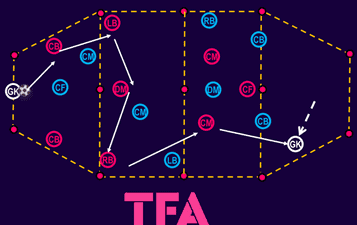
The aim of the in-possession team is to work the ball from one goalkeeper to the other whilst keeping the ball on the ground.
When they reach their intended target, the receiving goalkeeper then plays long to the goalkeeper who started the play.
The goalkeeper is free to move around their zone to create angles to receive from the attacking team.
This game can be used as a Match Day -1 preparation exercise.
The rules of the game and the lines on the pitch keep players in their respective positions.
Therefore, the coach does not have to continually remind players of their starting positions when working on a specific shape.
Without the use of the wide area, players have to find solutions to attacking centrally.
Again, without the coach having to constantly reinforce to their team to play through their midfielders, the design of the game itself forces these combinations.
Switching Via Midfield Possession Game
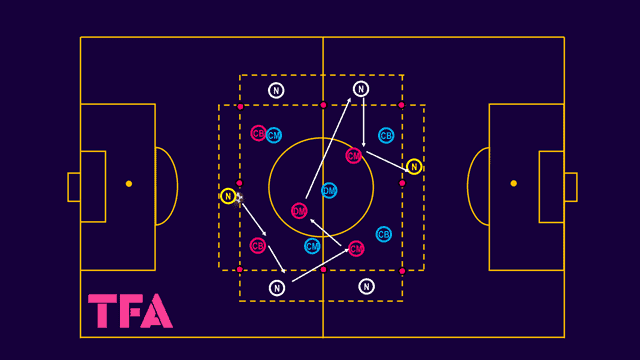
Similar to the octagon possession exercise, this setup is designed to mimic specific tactical conditions.
Here, the purpose is to switch the ball via midfield from one wide area to the other.
The yellow and white players are neutral, with the yellow representing goalkeepers and strikers, and the white representing wide full-backs and wingers.
The exercise aims to work the ball from one wide area to the other.
To score a point, the in-possession team must start from a yellow player and work the ball from one side to the other before finding the other yellow player, who’s playing as a target player.
Once the ball goes into the forward, the game continues in the opposite direction.
When the defending team wins the ball, they must first play into an end player, receive it back, and then work the ball from side to side.
As the game develops, and if the defending team begins to overprotect the wide area, leaving the striker open, the rules can be adapted to allow the attacking team to play directly into the forward.
Another condition that can be added is for the neutral players in the wide areas (white) to have to play the pass back into the middle players with just one touch.
This condition forces the midfield players to support the ball quickly when it goes wide.
The exercise can be particularly useful for preparing for an opposition that employs man-to-man marking in the centre of the pitch.