
Coaching The Modern Counter-Attack: From Ball Recovery to Chance Creation - Tactical Theory

Counter-attacking remains one of the most effective attacking strategies in modern football. By exploiting the moments immediately after regaining possession, teams can attack against an unbalanced defensive structure, create numerical advantages, and generate high-quality scoring opportunities with relatively few passes.
While many coaches focus heavily on possession-based attacks, the ability to transition quickly from defence to attack is often what separates good teams from great ones.
In this tactical theory, we examine the key principles behind successful counter-attacking football and explore practical training exercises that coaches can use to develop speed, decision-making, and attacking efficiency during transition moments.
Key Principles Of Counter-Attacking
In transition moments, one needs to take advantage of the disorganisation of the opponent.
But as your own team also needs to transition from one phase to the other, it is often described as “controlling the chaos”.
The following principles should help your team to control the transition phase from defence to attack.
Limited Time To Take Advantage
Firstly, time is everything.
As teams need about five to eight seconds to regain their defensive shape, one needs to make use of this short time window.
Therefore, it is important to keep pace high during a counter-attack.
Get To Goal As Fast As Possible
The most common mistakes during a counter-attack are passes played behind teammates.
To avoid slowing down the attack, one should make use of the huge space that is often given.
Pass The Ball Into Space
As with any attack, whether counter-attack or positional, one should never forget to move towards the goal.
As seen in plenty of counter-attacking opportunities, when the opposition defence only has two or three players in the back line, they will struggle to defend the whole width of the pitch.
That allows the counter-attacking players to play through more central areas.
Playing onto the wings is a no-go in these situations since it only creates further distance towards the goal.
Provide As Much Width As Needed
Winning the ball high up the pitch often means that only a few players are providing offensive passing options.
However, it is vital for the more defensive players to support the attackers for two reasons.
Firstly, it is possible to create numerical advantages near the opposition's goal.
Secondly, it helps to keep a compact shape to win second balls.
Support Your Attackers
Last but not least, given that the team created a numerical advantage, one often watches teams unable to finish in 3v2 or 4v3 situations as they do not utilise their advantage correctly.
The ball-carrier often plays a pass without any pressure.
This increases the risk of an interception by a defender.
To avoid this kind of tragedy, teach your players to occupy defenders before passing the ball when in superior numbers.
Individual Requirements For A Counter-Attack
Although counter-attacking is often seen as regaining possession and finishing as quickly as possible, different strategies need to be separated.
It is important to distinguish between coaching the individual, coaching groups and coaching the whole team.
It is helpful to start teaching the individual skills before adapting them into groups, and last but not least, with the whole team.
The individual requirements for a successful counter-attacking strategy are quick thinking and decision-making on a mental and tactical level.
Dribbling out of pressure, conquering space, accurate passing, and finishing under pressure on a technical level are equally important.
These aspects can already be included in a warm-up drill of a training session.
Counter-Attacks With Numerical Advantage
Starting to coach and teach the principles of counter-attacking in smaller groups, the following drill is useful and fun for players of any level.
It includes many transition moments, dribbling, and finishing at a high pace.
The idea lying behind the drill is to teach how to exploit numerical advantage in counter-attacking moments.
Therefore, two equal teams position themselves behind their goal.
One team starts to attack and finishes in a 1v0.
When the attack is finished, the opposition team starts an attack with two players entering the pitch in a 2v1.
This same procedure will be repeated two further times, creating 3v2 and 4v3 attacks.
This drill simulates the transition phases for both teams and thereby creates match-like attacks.
Moreover, the offside rule should be active to keep the situations as close to the real match conditions as possible.
To make sure that the players attack fast, every attack needs to be finished within eight seconds or less.
Depending on the level of your team, you will have to adjust the allowed amount of time per attack.
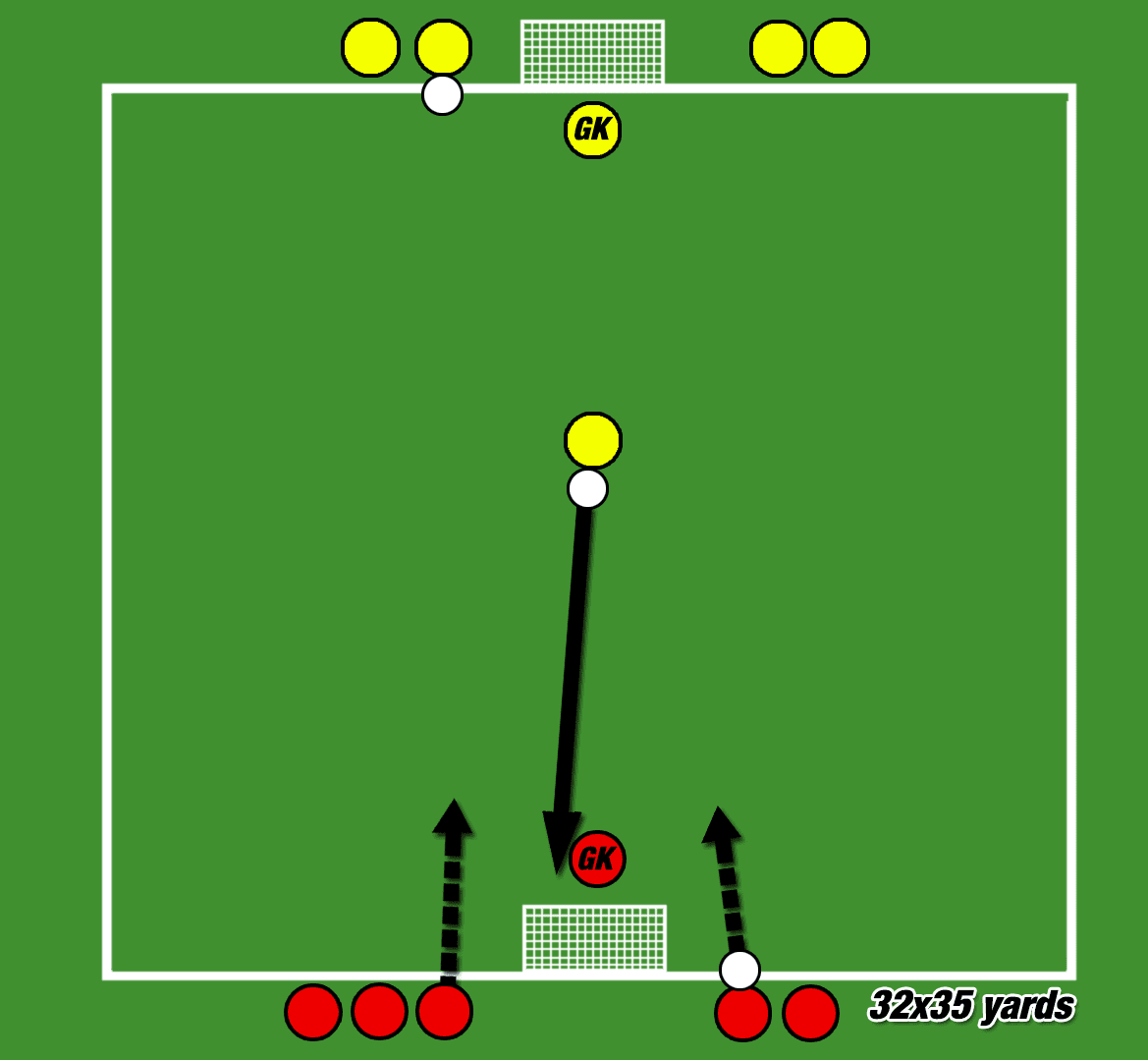
During breaks, the coach should illustrate the principles and correct the behaviour of the players.
Possible coaching points are the aforementioned principles of counter-attacking.
Occupying the opposition defenders by dribbling towards them is an important aspect of this drill.
This allows your team to make use of the numerical advantage in this exercise and in matches.
Furthermore, the provided width is an important factor which should be mentioned when coaching your players.
Lastly, encourage your players to use overlapping runs and quick rotations to confuse the defenders.
Prepare With A Well-Organised Press
As counterattacks always result from defensive phases, the press should be a part of coaching counter-attacking.
The following drill gives an example of creating a drill that fits a certain press.
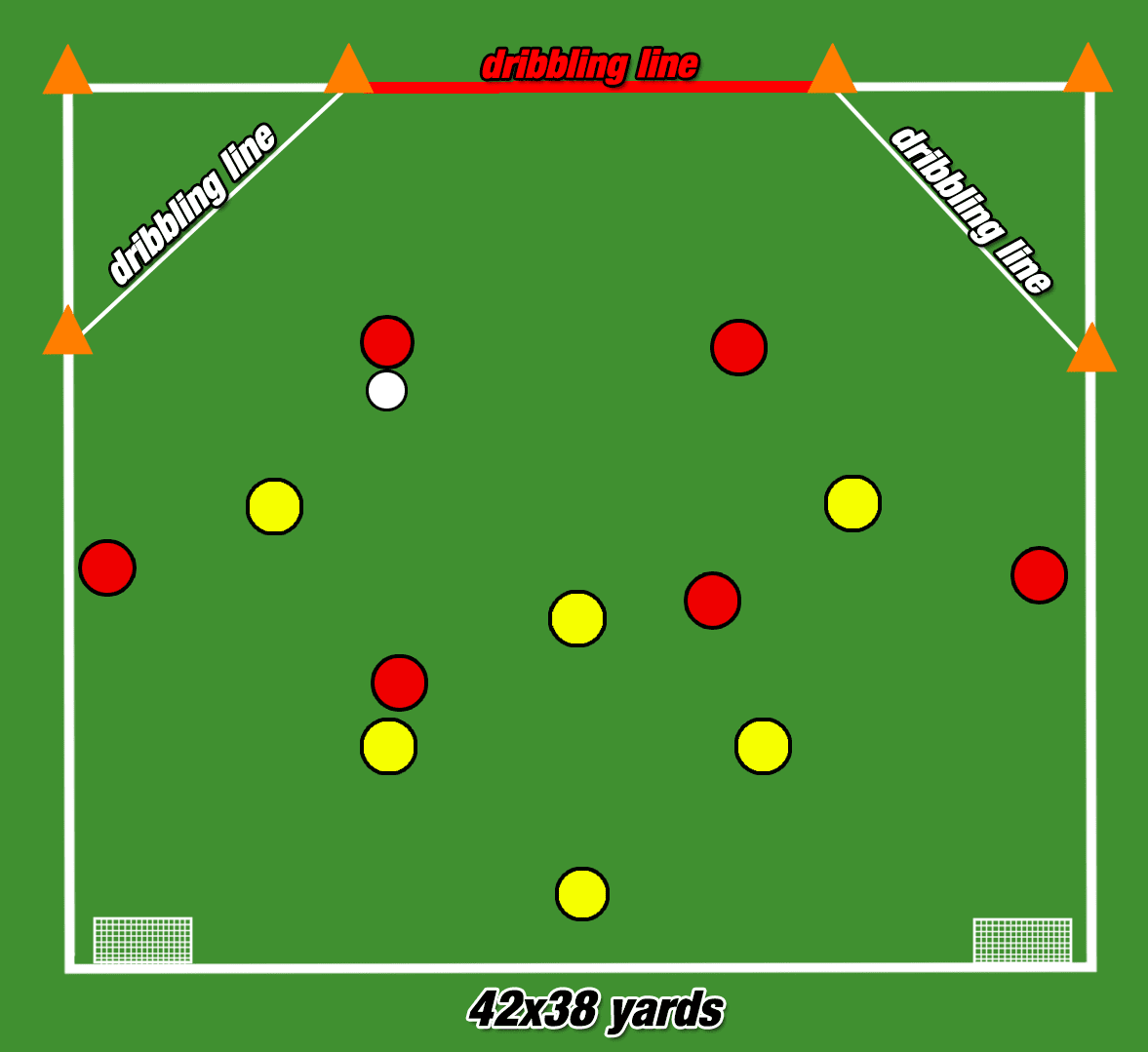
To force your players to guide the opposition inside, the build-up team should be provoked to play into wider areas.
Therefore, we set up a small goal on both wings right next to the sideline.
The pressing team will recognise that the centre is a less dangerous area.
As we do not want our players to think they can be outplayed in the centre without any risk, a dribbling line between the small goals enables the team playing out to score in the centre.
Whenever the pressing team wins the ball, they can counter-attack on three different dribbling lines.
The central one is rewarded with two points, and the wide ones are rewarded with one point.
To increase the number of counterattacks, the coach can play a new ball to the yellow team whenever the ball leaves the pitch.
As a possible variation, the counter-attacking side can only score by using the central dribbling line.
The diagonal sidelines will then force the attack towards the centre and goal.
This drill teaches the players to lead the opposition build-up into the centre to press and counter-attack.
However, it is still important to give the players the right introductions on how to press and how to counter-attack.
Create A Counter-Attacking Mentality
Although counter-attacking often includes only a few players touching the ball, all players need to be aware of how to act.
Therefore, it is necessary to practice counter-attacking as a team.
The following drill will create a counter-attacking mentality in your whole team.
This exercise is a usual 5v5 match, which evolves up to 8v8 with goalkeepers and two players of each team providing depth next to the opposition goal.
In addition to that, two neutral players move along the sideline to play with the team in possession.
In this exercise, the offside rule is inactive to allow the players to play into depth as early as possible.

The drill will encourage your players to play forwards as fast as possible without fear of losing the ball.