
![England Vs DR Congo [2–1] – FIFA World Cup 2026: Why The Three Lions' Defence Remains A Concern – Tactical Analysis](https://cdn.mymidnight.blog/77f959f119f4fb2321e9ce801e2f5163/size/w1000/2026/07/England-Vs-DR-Congo-World-Cup-2026.png)
England Vs DR Congo [2–1] – FIFA World Cup 2026: Why The Three Lions' Defence Remains A Concern – Tactical Analysis

England faced DR Congo in the Round of 32 of the 2026 FIFA World Cup, and the match ended with a 2-1 win for the English following a late comeback.
DR Congo were able to score the first goal, but were ultimately unable to protect their lead despite having created the chances to add a second goal.
Overall, this was a positive participation from Sébastien Desabre’s side, who achieved the best World Cup result in their history by reaching the Round of 32, as this was the first time they qualified for the knockout phase.
With a draw against Portugal, a win against Uzbekistan, and a loss against Colombia, DR Congo succeeded in passing the group stage among the best third-placed teams for the first time.
On the other side, Thomas Tuchel’s men qualified for the knockout phase by topping Group L after having beaten Croatia and Panama, while drawing to Ghana.
England’s performances have indeed been good enough so far, but there are some aspects that need to be improved ahead of the next rounds.
That’s why this World Cup tactical analysis article focuses mainly on how DR Congo were able to disturb England’s defensive organisation, score a goal and get close to adding a second.
The analysis also sheds light on England’s defensive errors and weaknesses that led to them conceding such chances.
England Vs DR Congo Lineups & Formations
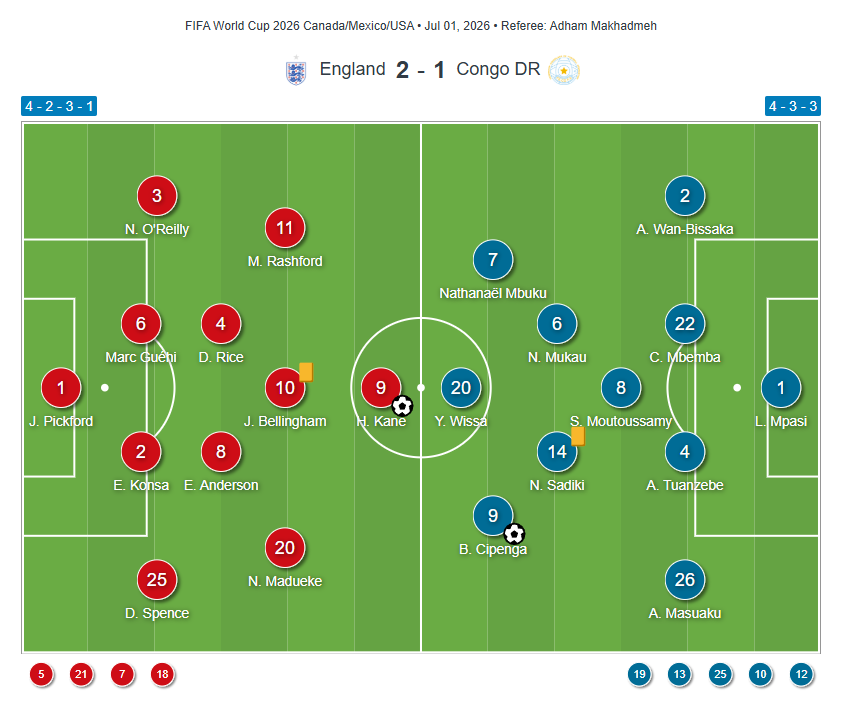
England Lineup Vs DR Congo
Tuchel preferred to start the match using a 4-2-3-1 formation with Jordan Pickford as a goalkeeper, and a backline made up of Ezri Konsa and Marc Guéhi as centre-backs, Djed Spence as a right-back, and Nico O'Reilly as a left-back.
The midfield was formed of Elliot Anderson and Declan Rice as central midfielders, Jude Bellingham as the advanced playmaker, Marcus Rashford and Noni Madueke as wingers, with Harry Kane as the main striker.
DR Congo Lineup Vs England
On the other hand, Desabre used a 4-3-3 formation with Lionel Mpasi in goal, and a defensive line composed of Chancel Mbemba and Axel Tuanzebe as centre-backs, Aaron Wan-Bissaka as a right-back, and Arthur Masuaku as a left-back.
The midfield was made up of Samuel Moutoussamy, Ngal'ayel Mukau, and Noah Sadiki, while the attacking trio featured Brian Cipenga and Nathanaël Mbuku as wingers, with Yoane Wissa as the main striker.
DR Congo Intensity & Diamond Passing/Positioning On The Flanks
DR Congo were outstanding in the way they started the match as they showed no fear whatsoever against a strong team.
On the contrary, DR Congo’s start to the match was exemplary since they were solid enough in defence through compact defending in the middle while conceding some space in wide areas.
Despite that, they were able to limit England’s wingers from cutting inside or penetrating through the box when in possession of the ball out wide.
At the same time, DR Congo succeeded in being dangerous on the ball and showed a lot of personality and clear ideas in possession.
Instead of retreating and playing a defensive game, DR Congo preferred to start with attacking and having as much possession as possible, with the aim being to advance quickly through quick passing towards the wings and not just have horizontal/passive possession.
Choosing to play attacking football was a gamble that paid off for DR Congo simply because retreating and defending in their zone while clearing the ball away when possible and remaining in their own half for the whole match would have led to a catastrophic result against a team like England.
Creating issues for England in their own final third and showing them that they score at any time was rewarding for DR Congo, as it forced England to defend and retreat on more than one occasion instead of just trying to score.
DR Congo relied mainly on a diamond passing style in midfield and especially on the wings, with consistent movements without the ball to escape from marking and provide passing solutions to the ball holder.
These first-touch quick passes were recurrent and helped DR Congo get away from England’s intensity and double marking in midfield.
In addition to that, these quick passes were often concluded by a through pass in space to one of the two wingers, exploiting England’s intensity in midfield and lack of coverage in wide areas.
This example highlights this diamond passing style that was adopted by DR Congo on more than one occasion to beat England’s midfielders and defenders.
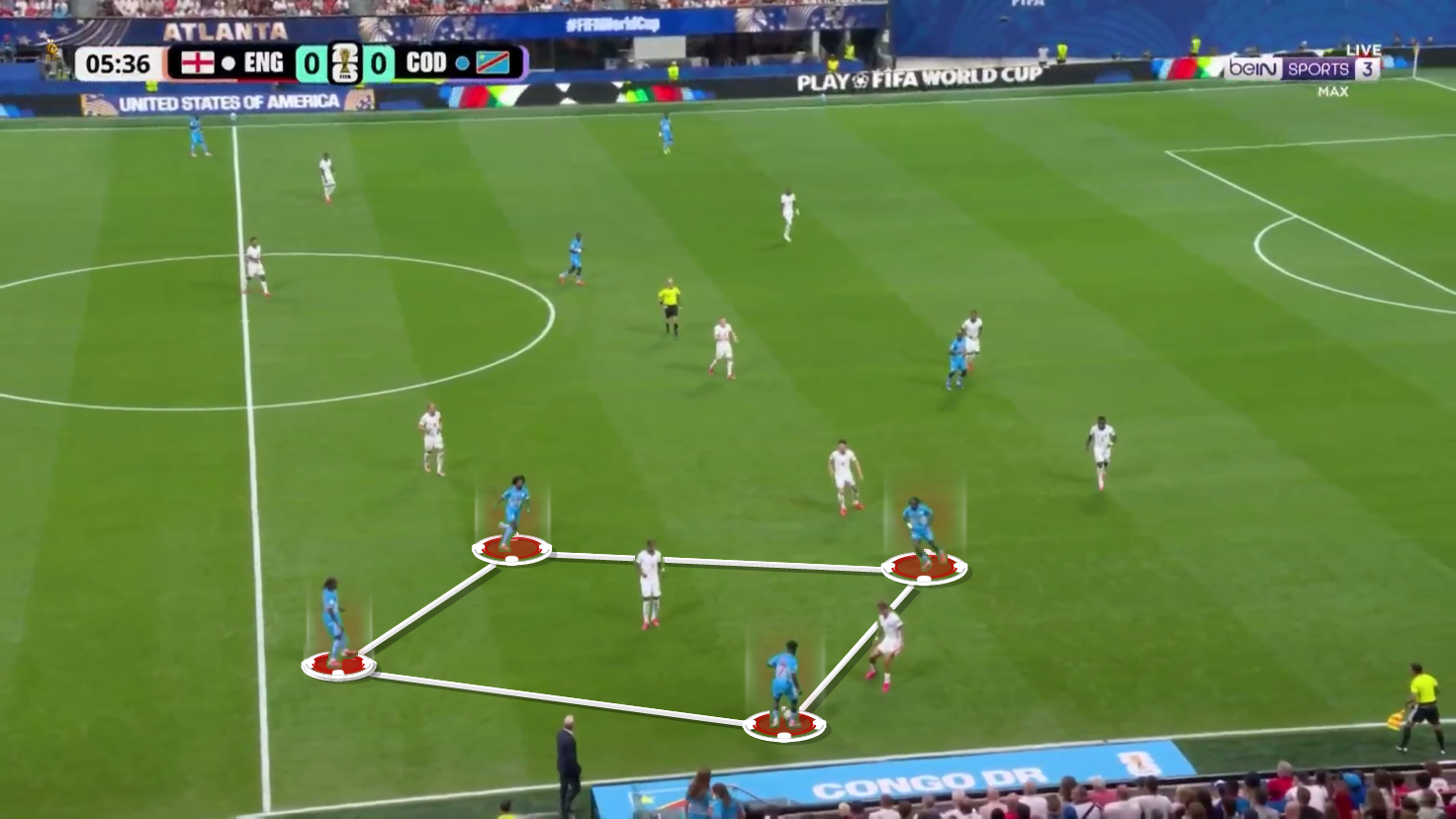
DR Congo’s ball possession, which was consistent inside England’s half, created some defensive confusion among the English and allowed DR Congo to believe even further in their ability to break that defensive line by continuing to use their quick passing, off-the-ball movement, and dribbling abilities of their wingers.
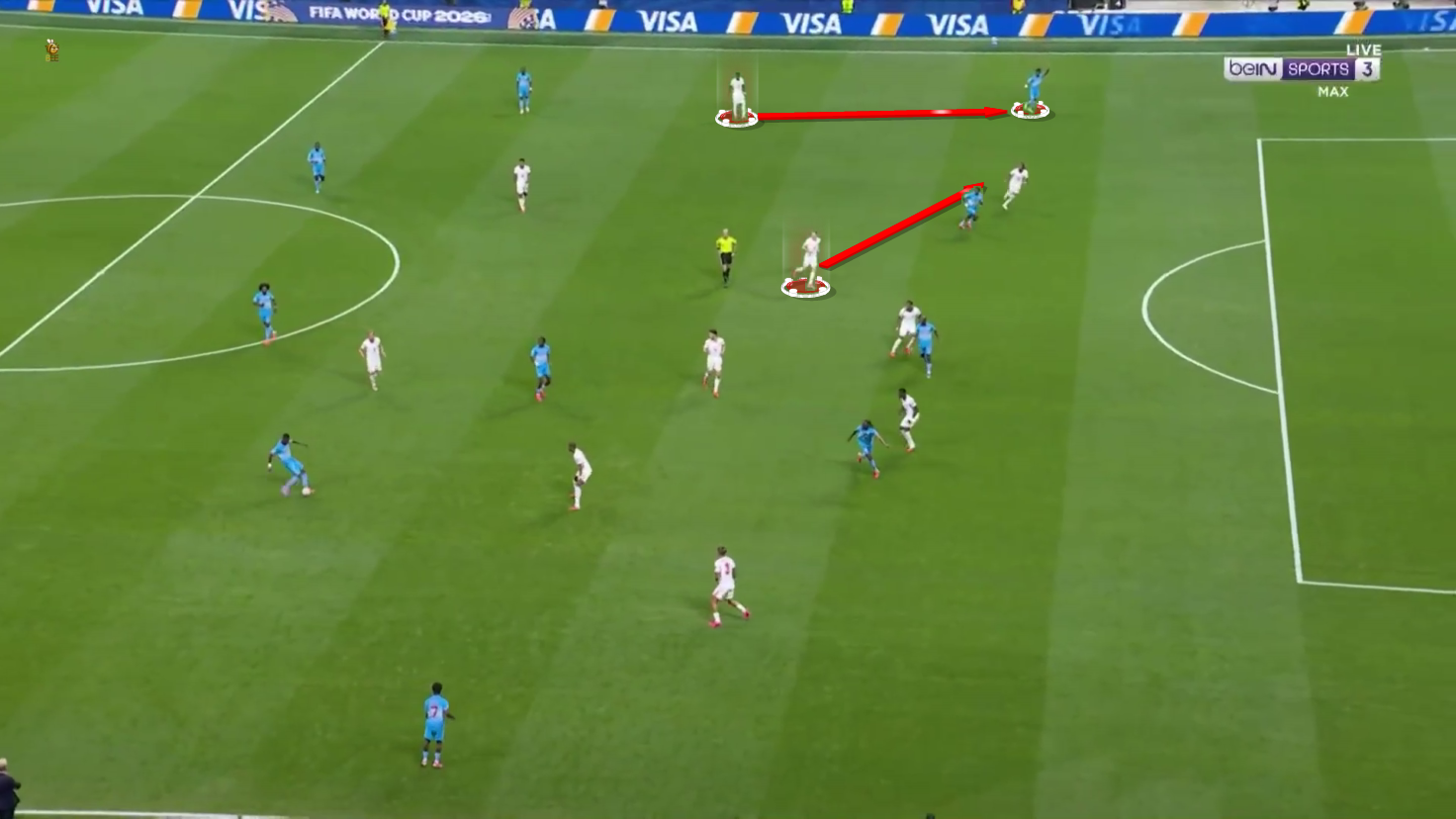
The goal action was born mainly thanks to Mbemba’s cross, which was oriented towards Sadiki’s penetration.
During this crossing attempt, Spence had to mark Sadiki and prevent him from running towards the goal without marking, since both Guéhi and Konsa did not notice this penetration on time and were busy marking Wan-Bissaka and Wissa.
This led to a perfect situation for Cipenga, who followed the cross and found himself completely unmarked with the ball inside the box; the perfect scenario for a winger.
What made this action possible was also the underestimation of Cipenga’s talent and DR Congo’s potential wide threats in general, as that was obvious in Madueke’s reluctant retreat to support Spence.
The same applies to Anderson, who could have read the situation better and leaned towards Cipenga to prevent him from shooting.
Overall, this numerical superiority situation that was created on the left wing was caused by England’s lack of discipline in supporting defenders, as well as the lack of understanding and communication between the defenders regarding individual marking.
Spence could have simply asked Konsa to mark Sadiki in this action and let Spence mark Cipenga to avoid falling in DR Congo’s trap.
![Scotland Vs Switzerland [0-3] UEFA Nations League 2026/2027: How Aggressive Pressing Backfired & Murat Yakin Took Advantage - Tactical Analysis](https://cdn.mymidnight.blog/77f959f119f4fb2321e9ce801e2f5163/size/w600/2026/10/Scotland-Vs-Switzerland-20262027---Tactical-Analysis.png)
![Olympique De Marseille Vs PSG [1-2] Ligue 1 2026/2027: How Bruno Génésio Transitions Troubled PSG - Tactical Analysis](https://cdn.mymidnight.blog/77f959f119f4fb2321e9ce801e2f5163/size/w600/2026/09/Marseille-Vs-PSG-2026_2027---Tactical-Analysis.png)
![Fulham Vs Manchester United [1-1] Premier League 2026/2027: How Álvaro Arbeloa Tactics Exposed The Red Devils' Problems - Tactical Analysis](https://cdn.mymidnight.blog/77f959f119f4fb2321e9ce801e2f5163/size/w600/2026/09/Fulham-FC-Vs-Man-United-2026_2027---Tactical-Analysis.png)
![AS Roma Vs Inter Milan [2-2] Serie A 2026/2027: When Undefeated Giallorossi Attack Met Nerazzurri Comeback Resilience - Tactical Analysis](https://cdn.mymidnight.blog/77f959f119f4fb2321e9ce801e2f5163/size/w600/2026/09/AS-Roma-Vs-Inter-Milan-2026_2027---Tactical-Analysis.png)
![Real Sociedad Vs Bournemouth [1-2] Europa League 2026/2027: How Do Marco Rose Pressing Tactics Work? - Tactical Analysis](https://cdn.mymidnight.blog/77f959f119f4fb2321e9ce801e2f5163/size/w600/2026/09/Real-Sociedad-Vs-Bournemouth-20262027---Tactical-Analysis-1.png)
![AC Milan Vs Benfica [0-2] Europa League 2026/2027: How Marco Silva Tactics Exposed Rúben Amorim Defensive Problems - Tactical Analysis](https://cdn.mymidnight.blog/77f959f119f4fb2321e9ce801e2f5163/size/w600/2026/09/AC-Milan-Vs-Benfica-20262027---Tactical-Analysis.png)
![Sunderland Vs AZ Alkmaar [1-0] Europa League 2026/2027: Why The Black Cats Make Better Underdogs - Tactical Analysis](https://cdn.mymidnight.blog/77f959f119f4fb2321e9ce801e2f5163/size/w600/2026/09/Sunderland-Vs-AZ-Alkmaar-20262027---Tactical-Analysis.png)