
![France Vs Senegal [3–1] – FIFA World Cup 2026: Didier Deschamps' Second-Half Solution – Tactical Analysis](https://cdn.mymidnight.blog/77f959f119f4fb2321e9ce801e2f5163/size/w1000/2026/06/France-Vs-Senegal-World-Cup-2026.png)
France Vs Senegal [3–1] – FIFA World Cup 2026: Didier Deschamps' Second-Half Solution – Tactical Analysis

France opened their 2026 FIFA World Cup campaign with a 3-1 win over Senegal, but this was far from a routine attacking performance from Didier Deschamps’ side.
For 45 minutes, France looked disconnected in possession, unable to turn their technical superiority into a sustained final-third threat.
Senegal’s compact defensive structure restricted central access, forced France into wide circulation, and left Kylian Mbappé isolated between the centre-backs.
Then, the game changed.
Rather than making an immediate personnel change, Deschamps altered France’s positional structure.
Michael Olise, who had started on the right but often dropped deep to help the build-up, was moved into a more central role behind Mbappé.
Ousmane Dembélé shifted wider, France gained better access between the lines, and Senegal’s previously stable defensive block began to lose its references.
In this tactical analysis, we examine how Senegal tactics frustrated France in the first half, why France’s initial attacking structure lacked balance, and how Olise’s central role transformed the match after the interval.
France Vs Senegal Lineups & Formations
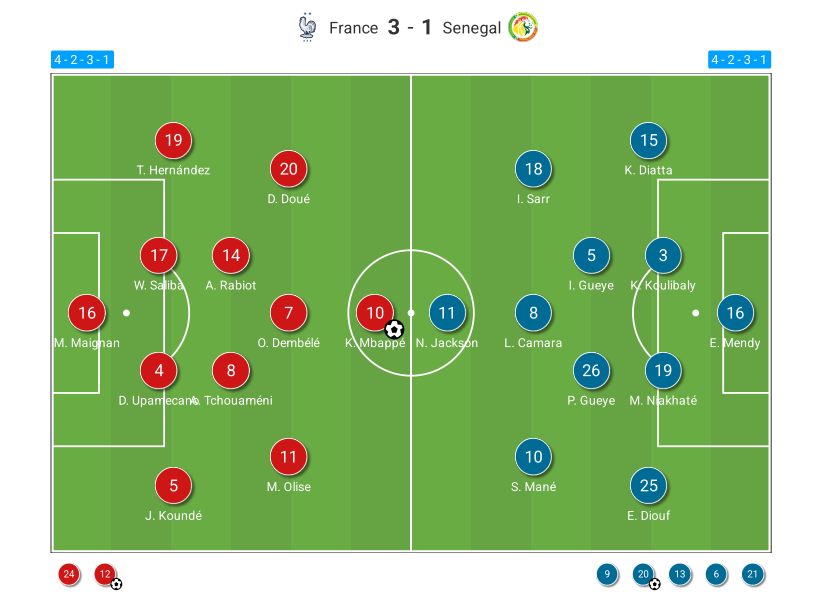
France Lineup Vs Senegal
France started in a 4-2-3-1, with Mike Maignan in goal and a back four of Jules Koundé, William Saliba, Dayot Upamecano, and Theo Hernández.
Aurélien Tchouaméni and Adrien Rabiot formed the double pivot, while Dembélé, Olise, and Désiré Doué played behind Mbappé.
On paper, this gave France an extremely flexible front four.
Dembélé could receive between the lines, Olise could drift inside from the right, Doué could attack from the left, and Mbappé could either pin the centre-backs or move into the left channel.
Senegal Lineup Vs France
Senegal were displayed in a 4-2-3-1 on the lineup graphic, with Édouard Mendy in goal, Kalidou Koulibaly and Moussa Niakhaté as the centre-back pairing, Krépin Diatta and El Hadji Malick Diouf as full-backs, and Idrissa Gana Gueye and Pape Gueye forming the deeper midfield pairing.
Lamine Camara operated ahead of them, with Ismaïla Sarr and Sadio Mané supporting Nicolas Jackson.
However, Senegal’s defensive behaviour was more important than the nominal formation.
Out of possession, their structure often resembled a compact 4-3-3 or 4-5-1 mid-block, with Sarr and Mané narrowing to protect central access while Camara, Gueye, and Pape Gueye remained close enough to deny France easy receptions between the lines.
This was not a passive low block.
Senegal still pressed when the ball travelled wide and looked to jump onto France’s full-backs, but their priority was to protect the middle of the pitch and force France into predictable circulation.
Senegal Mid-Block & France First-Half Problems
The first half was defined by France’s inability to connect their build-up with their attacking line.
Senegal’s front players did not always press France’s centre-backs aggressively.
Instead, they used their positioning to screen passes into midfield.
Jackson often stayed close to Tchouaméni, while Mané and Sarr curved their pressure to guide the ball towards Koundé or Hernández.
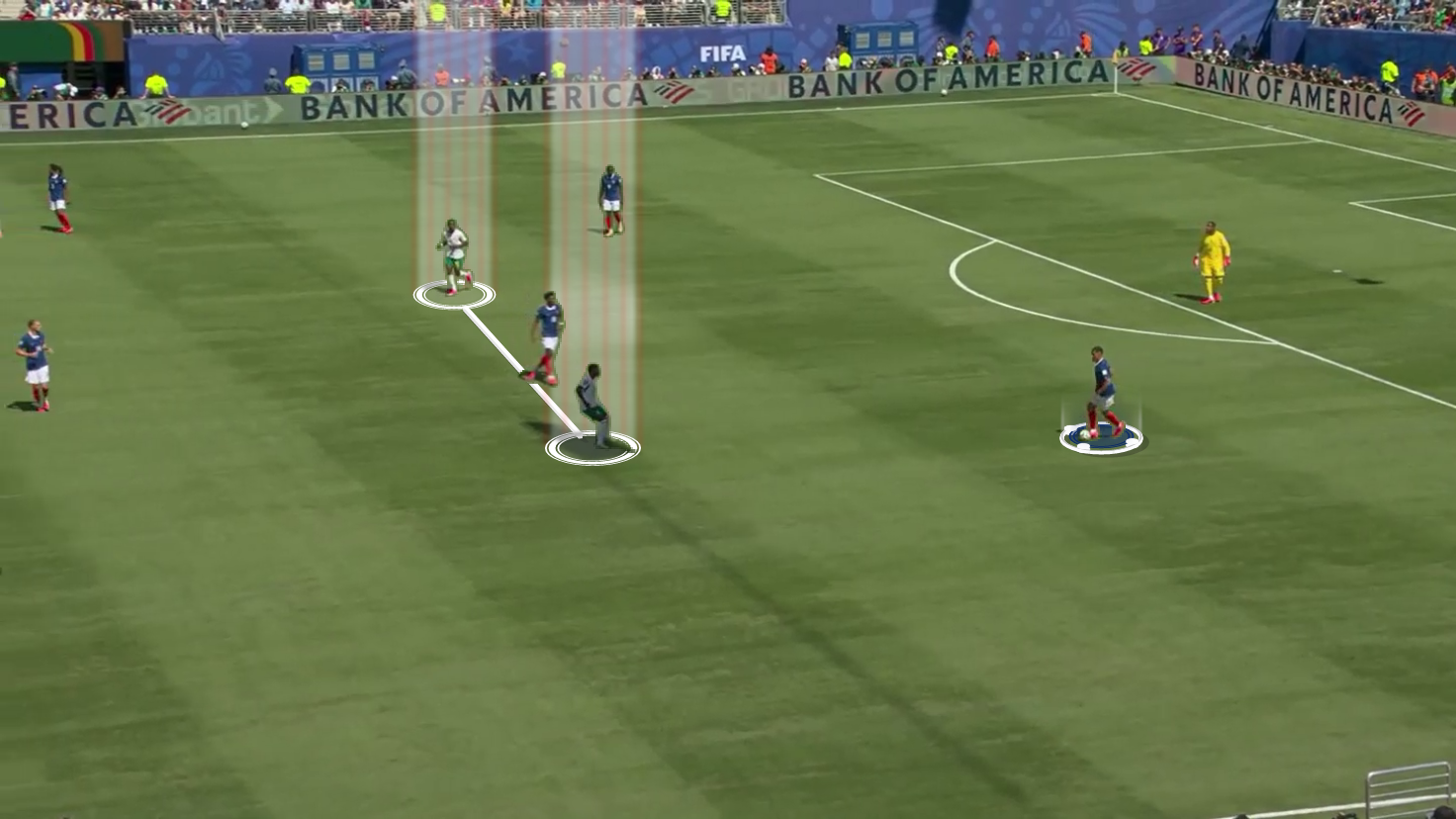
Senegal did not jump aggressively onto France’s centre-backs in the first phase.
Instead, they held a compact mid-block, screened the central passing lanes, and encouraged France to circulate towards the full-back zones.
This gave Senegal two clear advantages.
Firstly, France were forced towards the flanks, where Senegal could use the touchline as an extra defender.
Secondly, the midfield line could remain compact, making it difficult for Dembélé, Olise, or Doué to receive on the half-turn.
France’s own structure made this problem worse.
Olise started from the right but regularly dropped deeper to support progression.
At times, he moved close to Tchouaméni, or even towards Upamecano and Saliba, to offer an extra passing option.
This helped France keep the ball, but it also removed one of their most creative players from the spaces where he could hurt Senegal.
As Olise dropped, Dembélé also moved towards the ball, while Doué often came inside from the left.
The result was a congested attacking structure, with too many French players occupying similar central or right-sided zones.
That created a major imbalance.
Hernández was often left without a natural winger ahead of him on the left, while Senegal could slide across without being stretched horizontally.
Rather than forcing Senegal’s backline to defend the full width of the pitch, France allowed them to remain compact and connected.
Mbappé suffered from this most clearly.
Instead of receiving while travelling at speed or attacking the left channel, he was often forced to play as a fixed centre-forward against Koulibaly and Niakhaté.
Senegal could keep him close, deny him depth, and prevent France from finding him in dynamic situations.
France’s possession was therefore secure but sterile.
They had technical players near the ball, but not enough height, width, or central presence to destabilise Senegal’s block.
France Build-Up: Control Without Penetration
France did have logical mechanisms in the first phase.
When Senegal pressed with two players, Tchouaméni could drop between or beside the centre-backs to create a temporary three-man build-up.
This helped France secure numerical superiority and gave Upamecano and Saliba better passing angles.
Rabiot then had freedom to move slightly higher, often acting as a connector into the left half-space.
Koundé and Hernández provided the outside options, while Dembélé and Doué moved inside to receive in pockets.
The idea made sense; the problem was the spacing around the ball.
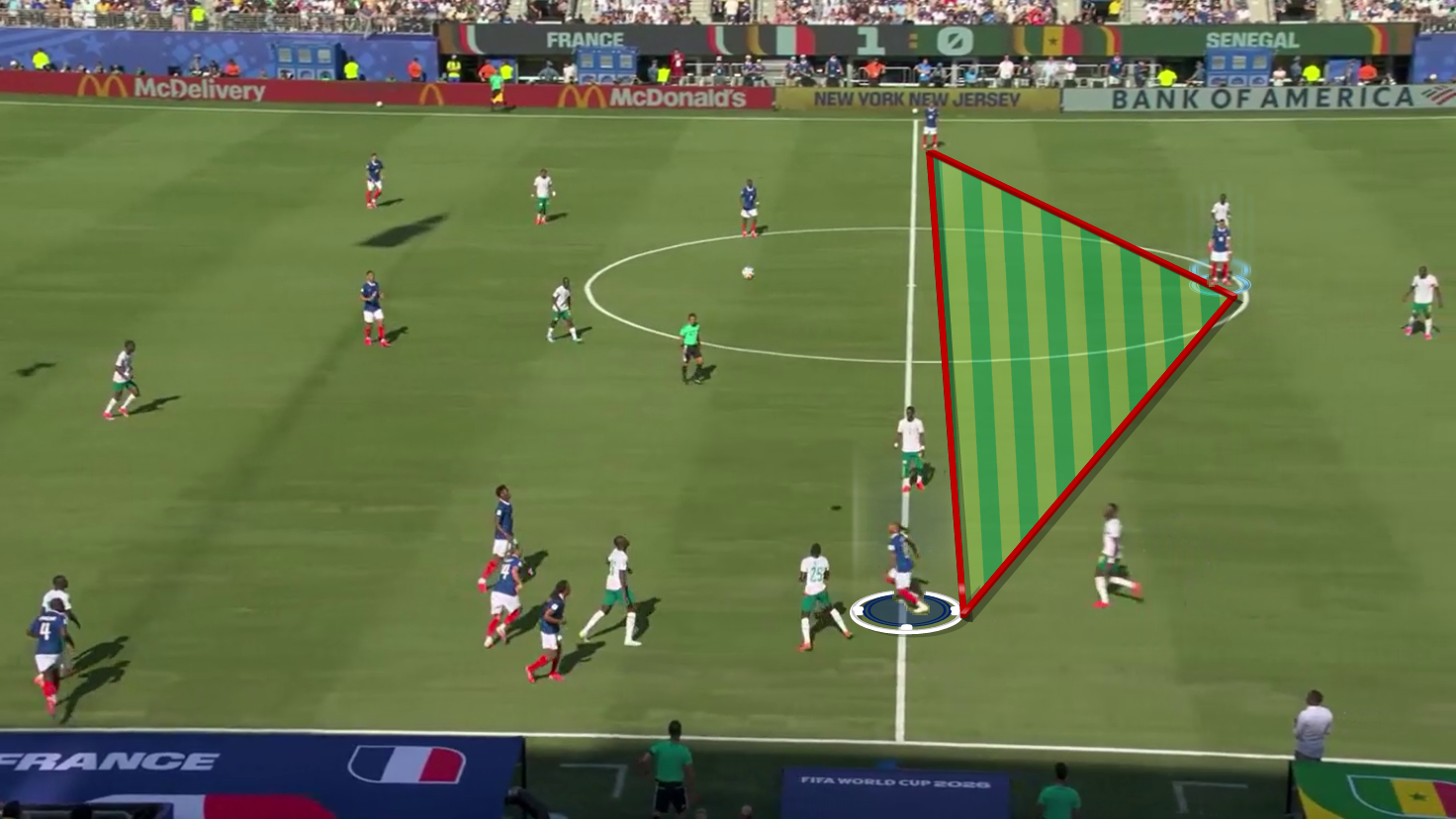
Olise dropped towards the right touchline to support France’s circulation, giving them an extra passing option in the build-up.
However, this also reduced France’s presence between the lines and left Mbappé more isolated against Senegal’s centre-backs.
Too often, France attracted too many players into the same area.
Olise’s deeper movements helped ball retention but reduced attacking presence.
Dembélé’s central positioning gave France another technical receiver but did not stretch Senegal’s defensive line.
Doué’s movements inside left the far-side width underused.
This made Senegal’s defensive task much easier.
Their midfielders could shift across together, protect the central lane, and press French receivers without leaving major spaces behind them.
Gueye and Pape Gueye were particularly important in controlling those areas, as they could step out aggressively and then recover back into the block.
Senegal also carried a transition threat.
When they won the ball, they looked quickly towards Jackson, Sarr, and Mané.
Jackson’s movement across the front line gave Senegal a reference point, while Sarr and Mané attacked the spaces either side of France’s centre-backs.
This meant France could not simply commit everyone forward without caution.
Their rest defence had to respect Senegal’s ability to break quickly into wide and inside channels.
Senegal Transition Threat & Wide Progression
Senegal’s most dangerous attacking moments came when they escaped France’s first counterpressure.
Because Hernández and Koundé were expected to support possession, there were moments when France left space behind their full-backs.
Senegal tried to exploit this by playing vertically into the channels, especially when Jackson could drag one of the centre-backs away from the defensive line.
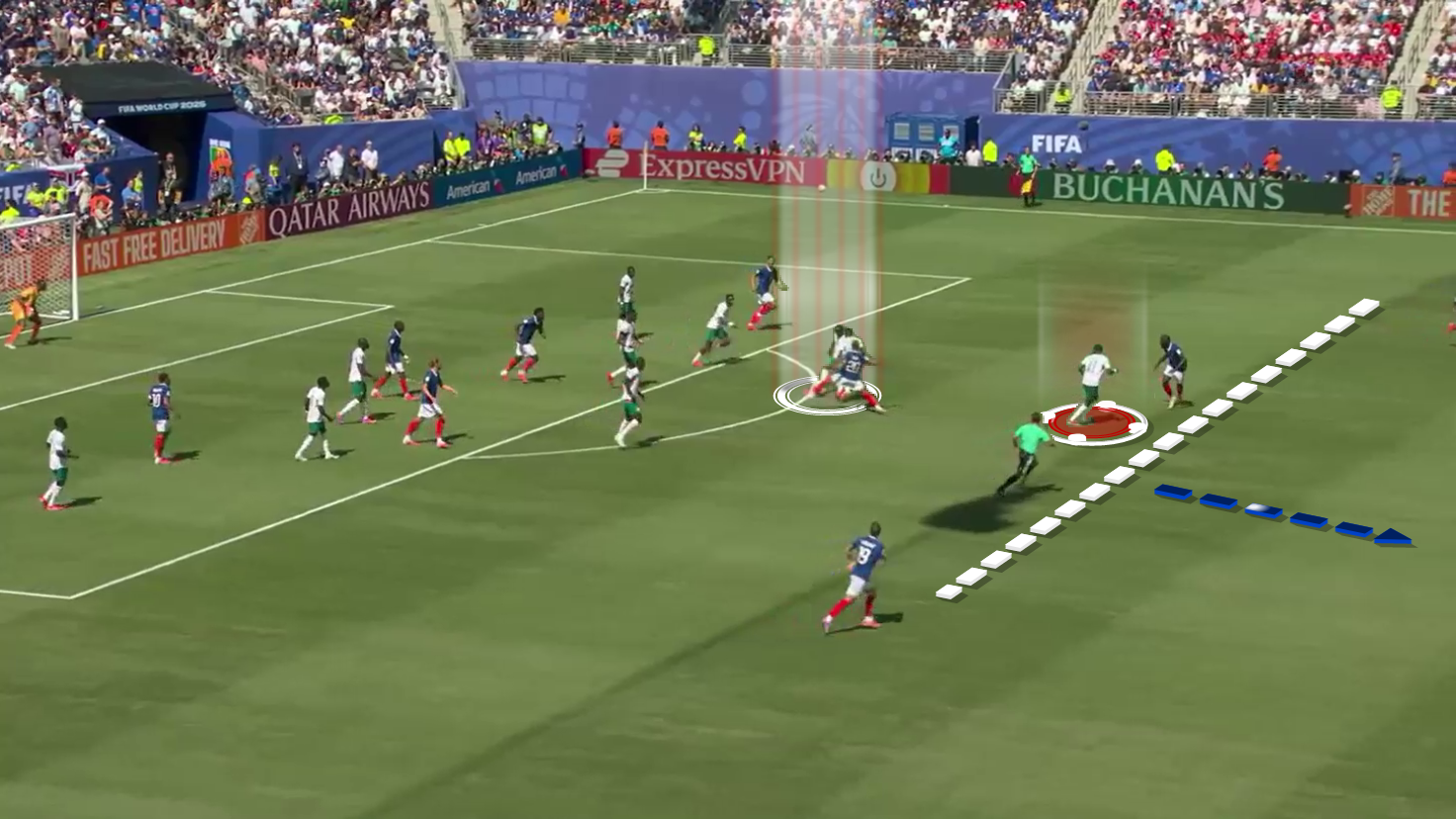
Senegal recover possession and immediately attack the open space before France can fully reset.
Although the situation is initially balanced, the distance between the French defenders leaves room for Senegal to accelerate.
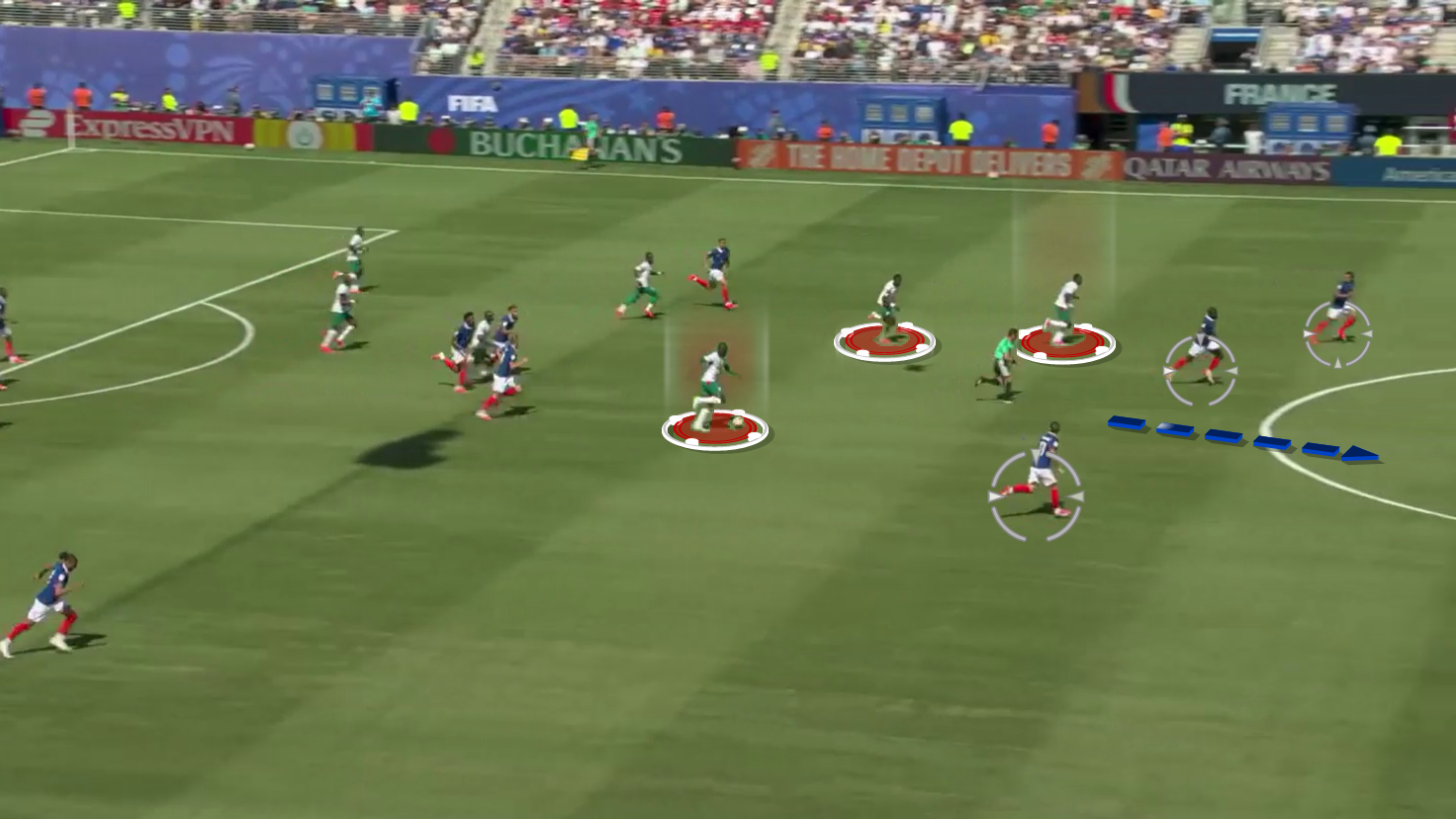
France recover into a nominal 3vs3, but Senegal’s speed and supporting runs quickly change the situation.
By opening the pitch and attacking at pace, Senegal turn numerical equality into a dynamic attacking superiority.
Sarr and Mané were also important because they did not simply hold wide positions.
They often moved diagonally inside, looking to attack the space between France’s full-back and centre-back.
This created difficult defensive decisions for Koundé and Hernández, who had to balance their attacking role with protection against transitions.
Senegal’s full-backs also contributed to progression.
Diatta offered forward running on the right, while Diouf gave Senegal an outlet on the left when France’s right side became narrow.
Although France finished with the better attacking numbers, Senegal were competitive territorially.
France recorded more completed line breaks and final-third receptions, but Senegal still found ways to progress and prevent the match from becoming one-way traffic.
That balance explains why the first goal was so important.
Until France changed their attacking structure, Senegal had enough control without the ball to keep the game close.
Didier Deschamps Tactics: Moving Michael Olise Central
The decisive adjustment came after half-time.
Deschamps moved Olise away from the right-sided role and placed him more centrally behind Mbappé.
Dembélé moved wider to the right, giving France more natural width, while Doué remained on the left before Bradley Barcola later replaced him.
This solved several problems at once.
Firstly, France finally had a high-level connector between Senegal’s midfield and defensive lines.
Olise was no longer receiving too deep; he was receiving in the zone Senegal least wanted him to occupy.
![Real Sociedad Vs Bournemouth [1-2] Europa League 2026/2027: How Do Marco Rose Pressing Tactics Work? - Tactical Analysis](https://cdn.mymidnight.blog/77f959f119f4fb2321e9ce801e2f5163/size/w600/2026/09/Real-Sociedad-Vs-Bournemouth-20262027---Tactical-Analysis-1.png)
![AC Milan Vs Benfica [0-2] Europa League 2026/2027: How Marco Silva Tactics Exposed Rúben Amorim Defensive Problems - Tactical Analysis](https://cdn.mymidnight.blog/77f959f119f4fb2321e9ce801e2f5163/size/w600/2026/09/AC-Milan-Vs-Benfica-20262027---Tactical-Analysis.png)
![Sunderland Vs AZ Alkmaar [1-0] Europa League 2026/2027: Why The Black Cats Make Better Underdogs - Tactical Analysis](https://cdn.mymidnight.blog/77f959f119f4fb2321e9ce801e2f5163/size/w600/2026/09/Sunderland-Vs-AZ-Alkmaar-20262027---Tactical-Analysis.png)
![Leeds United Vs Newcastle United [4-1] Premier League 2026/2027: Why Did Daniel Farke Tactics Dominate The Magpies? - Tactical Analysis](https://cdn.mymidnight.blog/77f959f119f4fb2321e9ce801e2f5163/size/w600/2026/09/Leeds-United-Vs-Newcastle-2026_2027---Tactical-Analysis.png)
![Real Sociedad Vs Atlético Madrid [0-3] La Liga 2026/2027: How Diego Simeone Tactical Precision Rescued A Late Victory - Tactical Analysis](https://cdn.mymidnight.blog/77f959f119f4fb2321e9ce801e2f5163/size/w600/2026/09/Real-Sociedad-Vs-Atl--tico-Madrid-20262027---Tactical-Analysis-1.png)
![Manchester United Vs Manchester City [0-1] Premier League 2026/2027: How Enzo Maresca Tactics Secured Victory With 10 Men - Tactical Analysis](https://cdn.mymidnight.blog/77f959f119f4fb2321e9ce801e2f5163/size/w600/2026/09/Manchester-United-Vs-Manchester-City--20262027---Tactical-Analysis.png)
![Tottenham Hotspur Vs Everton [0-0] Premier League 2026/2027: Why Can't Spurs Score? - Tactical Analysis](https://cdn.mymidnight.blog/77f959f119f4fb2321e9ce801e2f5163/size/w600/2026/09/Tottenham---Vs-Everton-20262027---Tactical-Analysis.png)
![West Ham United Vs Wrexham [6-0] EFL Championship 2026/2027: The Cost Of Passive Defending Against Smart Movement - Tactical Analysis](https://cdn.mymidnight.blog/77f959f119f4fb2321e9ce801e2f5163/size/w600/2026/09/West-Ham-United-Vs-Wrexham-2026_2027---Tactical-Analysis.png)