Paulo Fonseca Tactics At Olympique Lyonnais 2025/2026: Can His Adaptability, Overloads & Pressing Bring Lyon Sustained Success In 2026/2027? – Tactical Analysis
Paulo Fonseca has rebuilt Lyon around positional play, fluid attacking structures and aggressive pressing. This tactical analysis examines his 4-2-3-1, build-up patterns, defensive approach and the areas Lyon must improve in 2026/2027.

Who Is Paulo Fonseca?
Paulo Fonseca joined Olympique Lyonnais in January 2025, replacing Pierre Sage, who was sacked after a string of poor results.
Taking charge immediately, Fonseca guided Lyon to a sixth-place finish while going out to Rúben Amorim's Manchester United in the quarter-finals of the UEFA Europa League.
Due to financial irregularities, the club was hit with sanctions, and they were put under strict financial control, which meant regular starters like Rayan Cherki, Alexandre Lacazette, Georges Mikautadze and Lucas Perri had to be sold.
Despite these difficulties, Fonseca guided Lyon to a fourth-place finish in Ligue 1 last season, which saw them make the UEFA Champions League qualifiers.
They face Fenerbahçe in their Champions League playoff, with the second leg yet to be played after a 1-1 draw in the first leg, which took place in Türkiye.
In this Paulo Fonseca tactical analysis, we examine Fonseca's principles in possession and out of possession, assessing whether he can guide the club towards greater success in 2026/2027.
Olympique Lyonnais Formation & Key Players
Fonseca has always been a big proponent of the 4-2-3-1 formation, lining up in a traditional back four, with a double pivot in front of the centre-backs, who are required to be excellent ball-playing midfielders.
The front three behind the striker consist of an attacking midfielder and two wingers, where the wingers are expected to tuck in to allow the full-backs to overlap.
During the course of last season, Clinton Mata and Moussa Niakhaté were Fonseca's most trusted defenders.
Their presence added steel to the backline, which rewarded the trust shown by Fonseca.
Former Arsenal defender Ainsley Maitland-Niles clocked in as the defender with the third-most minutes for Les Gones last season.
With Zachary Athekame joining from AC Milan on a dry loan, it is to be seen whether his minutes will be maintained or reduced.
Former Liverpool player Tyler Morton, who joined Lyon in a €10m move in 2025, was found to be the revelation of the season in Ligue 1.
He was the midfielder who was handed the most minutes by Fonseca last term.
Lyon veteran and 2018 FIFA World Cup winner with France, Corentin Tolisso, formed an able partnership with Morton in the double pivot.
USMNT midfielder Tanner Tessmann clocked in enough minutes to feature in the top eight players used by Fonseca.
A player who benefitted the most from Fonseca was Portuguese winger Afonso Moreira.
He logged eight goals and 10 assists last season, earning himself a €30m move to Bundesliga side Bayer Leverkusen.
Paulo Fonseca Tactics In Possession
When building out from the back Lyon utilise a 3+2 structure during the initial build-up.
Fonseca would always like his goalkeeper to be good with his feet to participate in the build up, as seen with Mike Maignan in Milan and Lucas Chevalier in Lille (now Paris Saint-Germain).
This is primarily done with two objectives.
First, to allow the full-backs to push wide and stretch the pitch and the opposition’s shape, while the other objective is to keep the double pivot intact to prevent central overloads.
The centre-backs usually stay deep to allow Lyon to keep tight space between the three players at the back who are initiating the build-up.
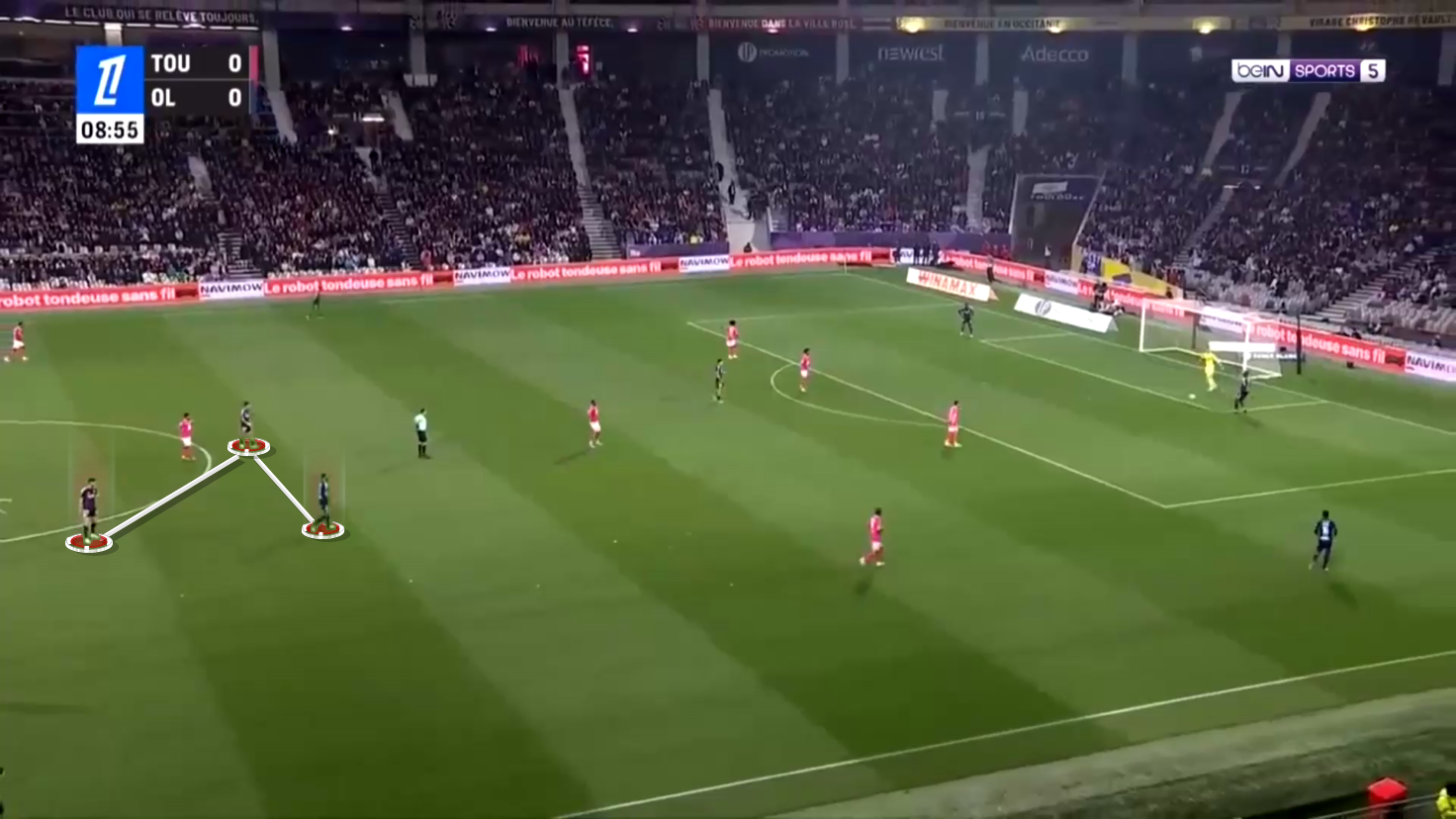
The second and one of the main objectives of this build-up shape is to create overloads against the opponents’ second line of defence.
As we can see in Figure 1, Lyon have created a 3v2 against Toulouse’s second line of defence.
To achieve this goal, Lyon have two distinct mechanisms in possession which they commonly use.
To bypass the first wave of pressure, Lyon use a third-man combination where they rely on quick one-touch passes between players to play out of the opposition press.
A second mechanism is having midfielders, usually the attacking midfielder, drop and drag a defender with him, thereby creating space.
A ball carrier, like Maitland-Niles, is able to carry the ball forward into the space recently vacated by the opposition defender.
Once Lyon bypass the opposition press, they tend to form a 3-2-5 structure in possession, as seen in Figure 2.
With both full-backs joining the front three form a temporary five-man attack, Fonseca instructs one of the men in his double pivot to drop into the back two and convert it into a back three.
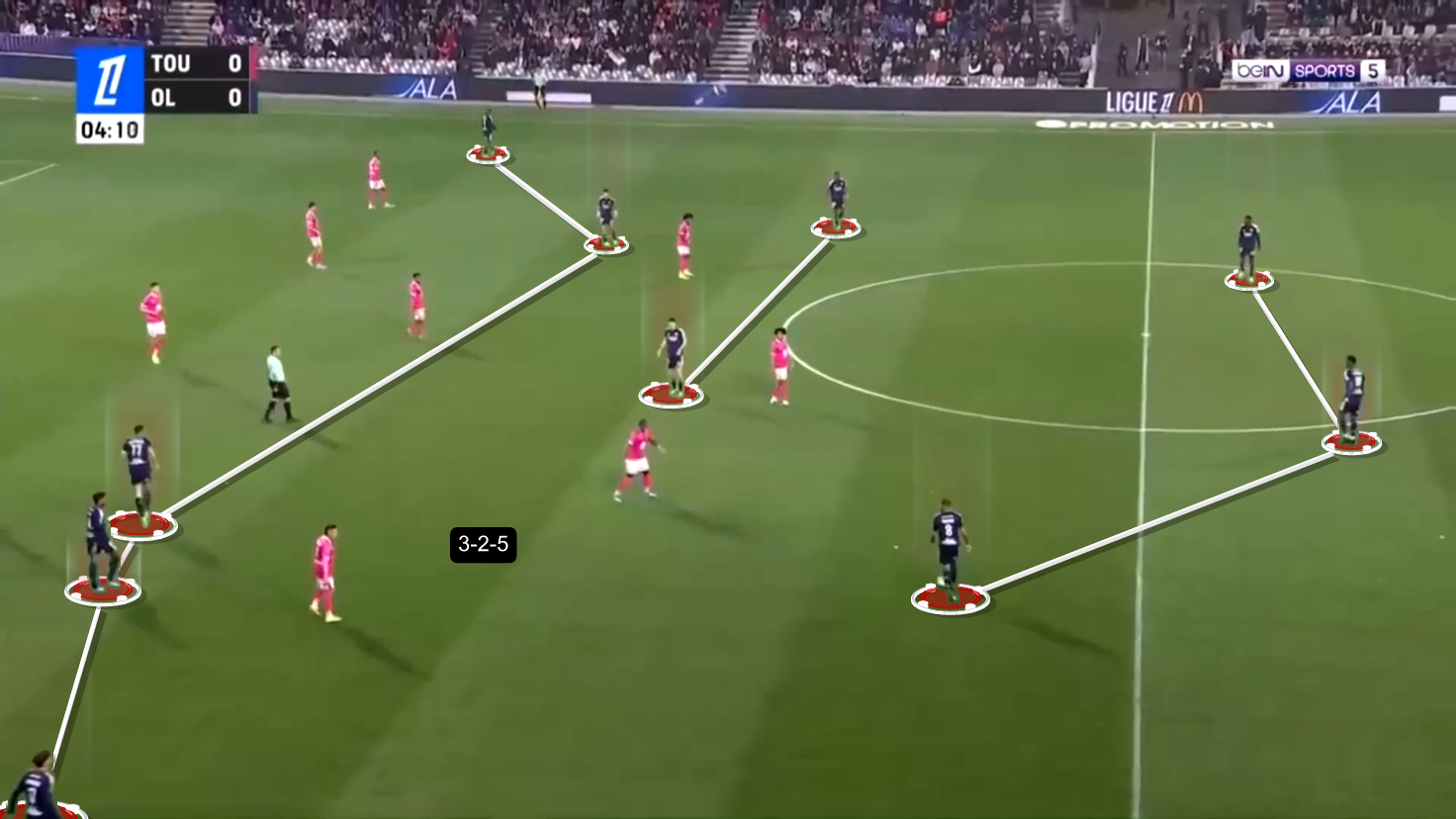
To compensate for the loss of a player in the double pivot, Fonseca instructs the attacking midfielder to drop into the double pivot the maintain the 3+2 balance in the rest defence.
Like any other positional play team, fluidity is a rather vital principle in Fonseca’s style, as players can switch positions in the system effortlessly, creating chaos and confusion for the opposition’s marking scheme.
With positional fluidity and good relations between players, Lyon look to create ball-side overloads, as seen in Figure 3.
Players cluster near the teammate on the ball and keep short distances between themselves so that quick one-touch passes can be played into each other quickly and the ball can be funnelled into the forwards.