
![Switzerland Vs Canada [2–1] – FIFA World Cup 2026: Patience Rewards Murat Yakin Tactics – Tactical Analysis](https://cdn.mymidnight.blog/77f959f119f4fb2321e9ce801e2f5163/size/w1000/2026/06/Switzerland-Vs-Canada-World-Cup-2026.png)
Switzerland Vs Canada [2–1] – FIFA World Cup 2026: Patience Rewards Murat Yakin Tactics – Tactical Analysis

Switzerland met Canada at the BC Place Vancouver Stadium for their third and last fixture of the 2026 FIFA World Cup group stage, with Switzerland winning 2-1 to top Group B.
With a draw against Qatar, a large win over Bosnia and Herzegovina, and a win against Canada, Switzerland qualify for the knockout phase undefeated, confirming that they will be tough to beat going forward, too.
This group stage success will reward Switzerland with a relatively favourable draw for the Round of 32, as they will face one of the best third-placed teams, specifically from group E/F/G/I/J.
Therefore, Murat Yakin’s side should qualify for the Round of 16 if they perform as expected, as they are considered superior to any of their potential opponents in the first knockout round.
On the other side, Canada were hoping to stay at home and start the knockout phase in Vancouver.
However, finishing second means that they will have to travel to Inglewood, California, in order to face South Africa.
Canada were hoping to avoid this situation in the knockout phase to continue playing in front of their supporters, receive a considerable boost during their games, and have more time to rest between this match and the Round of 32.
That said, Jesse Marsch’s men still have what it takes to challenge or beat South Africa for the qualification ticket, despite playing in the United States.
In this World Cup tactical analysis article, we focus mainly on Switzerland’s attacking performance and solutions, while shedding light on their most remarkable areas of improvement in attack/playmaking.
Switzerland Vs Canada Lineups & Formations
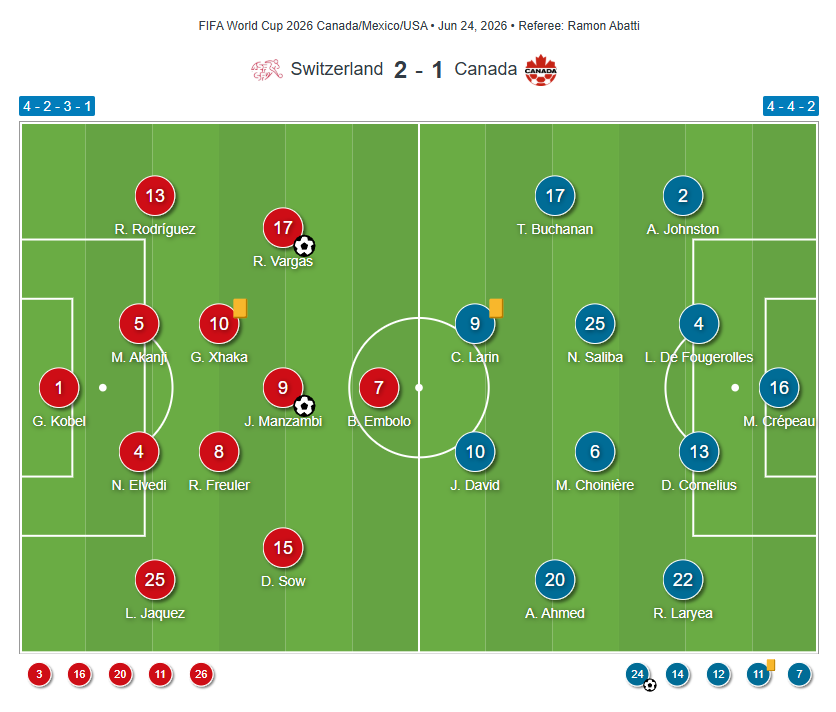
Switzerland Lineup Vs Canada
Yakin started the match using a 4-2-3-1 formation with Gregor Kobel as a goalkeeper, and a defensive line made up of Nico Elvedi and Manuel Akanji as centre-backs, with Luca Jaquez as a right-back, and Ricardo Rodríguez as a left-back.
The midfield was composed of Remo Freuler and Granit Xhaka as central midfielders, Djibril Sow and Rubén Vargas as wingers, with Johan Manzambi playing as an advanced playmaker at times, and as a second striker/winger at other times, behind the main striker, Breel Embolo.
Canada Lineup Vs Switzerland
For Canada tactics, Marsch relied on a 4-4-2 formation with Maxime Crépeau as a goalkeeper, and a defensive line composed of Luc De Fougerolles and Derek Cornelius as centre-backs, Alistair Johnston as a right-back, and Richie Laryea as a left-back.
In midfield, Marsch used both Nathan Saliba and Mathieu Choinière as central midfielders, Tajon Buchanan as a right winger, and Ali Ahmed as a left winger, while the attacking duo was made up of Jonathan David and Cyle Larin.
Switzerland Attacking Positioning Variety
Switzerland started the match more determined than Canada, with more possession and more attempts to reach the box.
This was eventually followed by some quick attacks for Switzerland, mainly thanks to Manzambi and Vargas’ creative movements without the ball and exchange of positions.
For instance, we saw Manzambi move to the left wing to create numerical superiority alongside Vargas.
Manzambi had the freedom needed to roam intelligently in more than one attacking position, as he was also involved in several actions in central areas inside the final third.
What made Switzerland even more unpredictable for Canada’s defensive lines was the continuous attacking support from both full-backs, whether with advancing or with vertical through passes.
That, alongside the consistent support of both Freuler and Xhaka in high pressing and key passing, was crucial for Switzerland to disrupt Canada with a variety of weapons.
In the following example, everything mentioned above is evident.
At the moment of Xhaka’s key long pass towards Vargas, Rodriguez was already advancing on the left wing and providing a passing option.
At the same time, Freuler did not hesitate to apply high pressing on Canada’s player, making a crucial high recovery and allowing Manzambi, who was in the middle of the final third, to get the ball.
As Manzambi was getting the ball, Vargas preferred to accelerate and steal the ball from Manzambi in order to accelerate the action and provide a pass to Embolo before he gets tightly-marked.
Embolo protects the ball well and blocks his direct marker, but fails to provide a suitable pass for a shot, preventing Sow from shooting on goal, as he fails to control the ball well enough due to the quality of the received pass.
This was an action that could have been better exploited, as it highlighted Switzerland’s attacking potential and their diverse attacking solutions.

![Scotland Vs Switzerland [0-3] UEFA Nations League 2026/2027: How Aggressive Pressing Backfired & Murat Yakin Took Advantage - Tactical Analysis](https://cdn.mymidnight.blog/77f959f119f4fb2321e9ce801e2f5163/size/w600/2026/10/Scotland-Vs-Switzerland-20262027---Tactical-Analysis.png)
![Olympique De Marseille Vs PSG [1-2] Ligue 1 2026/2027: How Bruno Génésio Transitions Troubled PSG - Tactical Analysis](https://cdn.mymidnight.blog/77f959f119f4fb2321e9ce801e2f5163/size/w600/2026/09/Marseille-Vs-PSG-2026_2027---Tactical-Analysis.png)
![Fulham Vs Manchester United [1-1] Premier League 2026/2027: How Álvaro Arbeloa Tactics Exposed The Red Devils' Problems - Tactical Analysis](https://cdn.mymidnight.blog/77f959f119f4fb2321e9ce801e2f5163/size/w600/2026/09/Fulham-FC-Vs-Man-United-2026_2027---Tactical-Analysis.png)
![AS Roma Vs Inter Milan [2-2] Serie A 2026/2027: When Undefeated Giallorossi Attack Met Nerazzurri Comeback Resilience - Tactical Analysis](https://cdn.mymidnight.blog/77f959f119f4fb2321e9ce801e2f5163/size/w600/2026/09/AS-Roma-Vs-Inter-Milan-2026_2027---Tactical-Analysis.png)
![Real Sociedad Vs Bournemouth [1-2] Europa League 2026/2027: How Do Marco Rose Pressing Tactics Work? - Tactical Analysis](https://cdn.mymidnight.blog/77f959f119f4fb2321e9ce801e2f5163/size/w600/2026/09/Real-Sociedad-Vs-Bournemouth-20262027---Tactical-Analysis-1.png)
![AC Milan Vs Benfica [0-2] Europa League 2026/2027: How Marco Silva Tactics Exposed Rúben Amorim Defensive Problems - Tactical Analysis](https://cdn.mymidnight.blog/77f959f119f4fb2321e9ce801e2f5163/size/w600/2026/09/AC-Milan-Vs-Benfica-20262027---Tactical-Analysis.png)
![Sunderland Vs AZ Alkmaar [1-0] Europa League 2026/2027: Why The Black Cats Make Better Underdogs - Tactical Analysis](https://cdn.mymidnight.blog/77f959f119f4fb2321e9ce801e2f5163/size/w600/2026/09/Sunderland-Vs-AZ-Alkmaar-20262027---Tactical-Analysis.png)