
![Norway Vs Senegal [3–2] – FIFA World Cup 2026: Ståle Solbakken Tactics Exploit Pape Thiaw Defensive Gamble – Tactical Analysis](https://cdn.mymidnight.blog/77f959f119f4fb2321e9ce801e2f5163/size/w1000/2026/06/Norway-Vs-Senegal-World-Cup-2026.png)
Norway Vs Senegal [3–2] – FIFA World Cup 2026: Ståle Solbakken Tactics Exploit Pape Thiaw Defensive Gamble – Tactical Analysis

Norway faced Senegal on matchday two of the 2026 FIFA World Cup, and it ended in a crucial 3-2 win for Norway.
It is a win that allows Norway to guarantee their qualification to the knockout phase prior to meeting France in their final group stage match in a game that will decide who finishes at the top of the group.
On the other hand, Senegal have now lost two games and have to win the last match against Iraq with a high goal margin in order to hope for qualifying among the best third-placed teams.
Their final game could prove tricky, too, given Iraq’s recent development.
Facing France and Norway cost Senegal momentum and undermined their confidence, despite having performed well against both sides.
It will be crucial for them to win the last match and hope for getting a qualification ticket based on the rest of the results.
In this World Cup tactical analysis, we explore Senegal’s errors in terms of approach, their attacking plan and weaknesses, as well as the reasons for losing the match.
The football analysis will also shed light on Ståle Solbakken's attacking tactics that helped Norway to get the advantage over Senegal.
Norway Vs Senegal Lineups & Formations
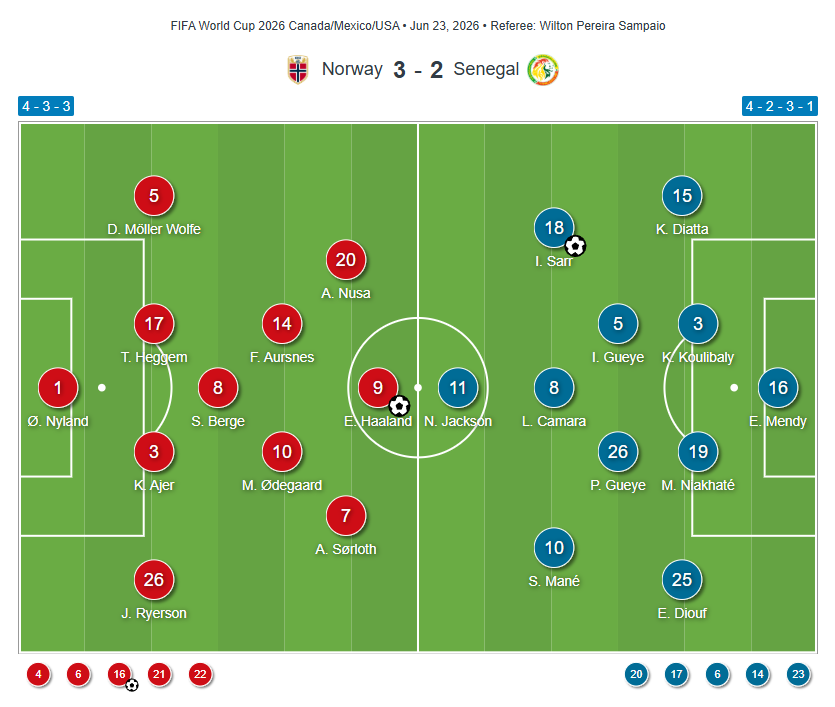
Norway Lineup Vs Senegal
Solbakken used the 4-3-3 formation with Ørjan Nyland as the goalkeeper, and a defensive line consisting of Torbjørn Heggem and Kristoffer Ajer as centre-backs, Julian Ryerson as a right-back, and David Møller Wolfe as a left-back.
In midfield, Solbakken used Sander Berge as the defensive midfielder, with Martin Ødegaard and Fredrik Aursnes as central midfielders.
In attack, he relied on Antonio Nusa and Alexander Sørloth on the wings, with Erling Haaland as the main striker.
Senegal Lineup Vs Norway
Meanwhile, Pape Thiaw used a 4-2-3-1 formation with Édouard Mendy as the goalkeeper and a backline of Moussa Niakhaté and Kalidou Koulibaly, plus Krépin Diatta and El Hadji Malick Diouf as full-backs.
The midfield was composed of Idrissa Gana Gueye and Pape Gueye as central midfielders, with Lamine Camara as the advanced playmaker, Ismaïla Sarr and Sadio Mané on the wings, and Nicolas Jackson as the main striker.
Senegal’s Wing-Based Attacks & Norway’s Ruthless Exploitation Of Space
Senegal Patient Possession-Based Style & Wing Solutions
Senegal played with a lot of confidence against Norway, adopting a possession-based style to avoid Norway’s dangerous attacks while remaining patient with the ball and trying to exploit Norway’s defensive mistakes, especially from the wings.
It is no secret that Senegal's main strengths and dangerous weapons are their wingers: Mané and Sarr.
Throughout the match, Senegal kept possession in hopes of creating wide overlaps, finding penetration, crossing, or passing to a player moving into the box.
These were Senegal’s main attacking plans for the match, in addition to relying on Jackson’s movements without the ball and trying to serve him with long passes when possible.
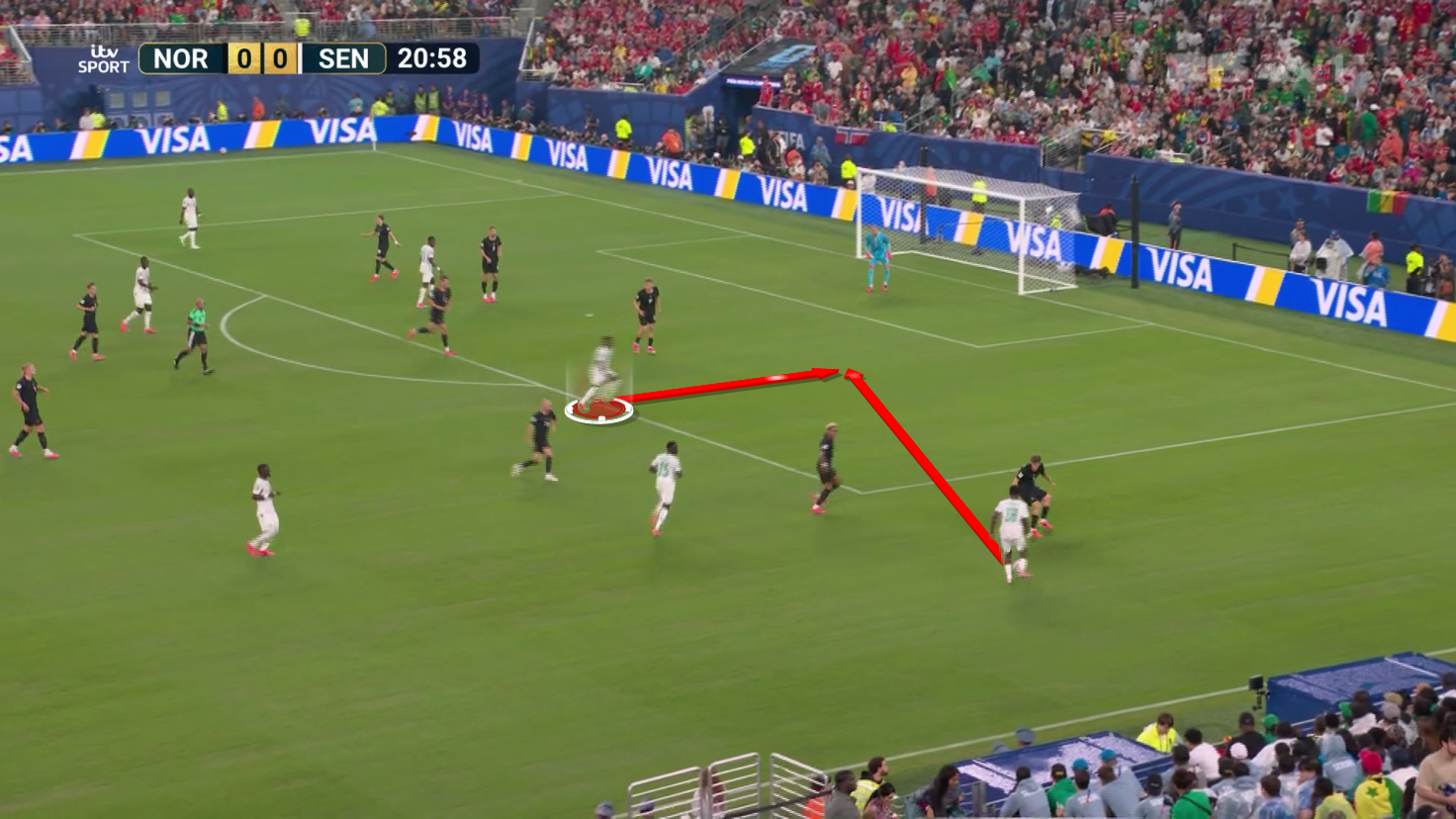
The following picture shows one of Senegal’s attempts to surprise and break down Norway’s defence, relying on patient possession that ended with a key pass towards the run from behind by the midfielder Camara.
The problem in this action was that Camara’s first touch was not as good as needed in order to allow him to win some precious time over Norway’s defender.
That first touch made him go for a cross while being closed down by his direct marker.
In this situation, it would have been much better for Camara to surprise both the goalkeeper and the defender with a first-time shot, as he had the space and time to do so.
Senegal Dangerous Mid/High Recoveries
In addition to their possession-based attempts and ideas, Senegal were even more dangerous on Norway’s defensive line, using their physical and athletic abilities to intercept the ball in midfield and inside Norway’s half.
These repeated mid- and high-level recoveries were dangerous for Norway, who were each time caught out by Senegal’s interceptions, and their defence lacked organisation during those moments.
However, Senegal failed to exploit some of these recoveries clinically, with final passing and off-ball movement to follow up on such quick counterattacks.
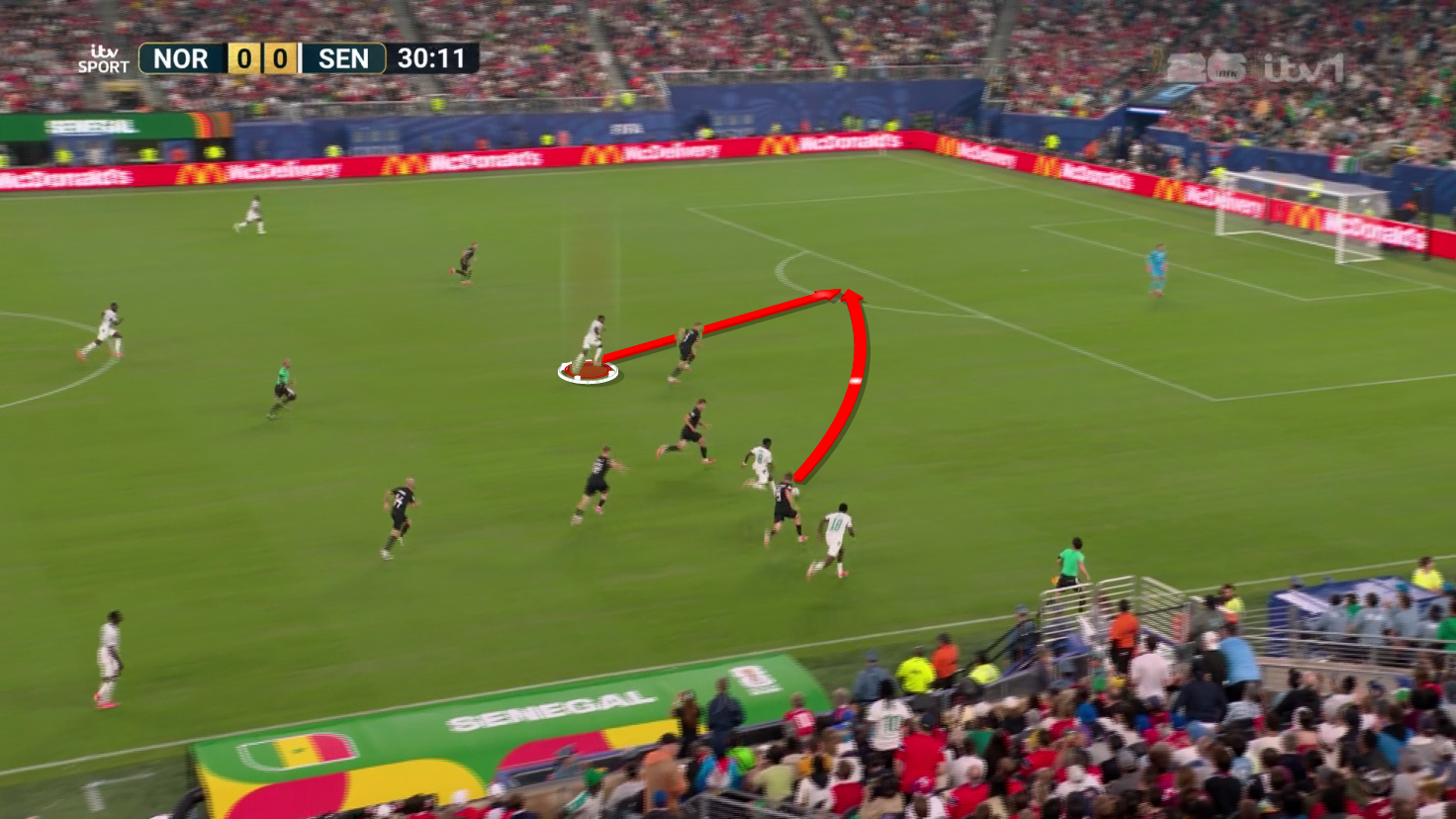
One of the most remarkable recoveries in the first half saw Camara make a very intelligent anticipation and interception in midfield, get away from another opponent, and then play a quick one-two with his teammate to dispossess another Norway player.
This helped him reach the final third very quickly and surprise Norway’s defence.
The only issue here was that Jackson did not make the needed movement to anticipate his direct marker and was too slow in his attempt to provide a passing option.
This made Camara’s pass look completely wrong, given that the latter also rushed his pass execution, which impacted accuracy.
That said, Jackson should have been much more useful without the ball in this situation, as he should have attacked the penalty box with more determination and conviction.
If he had done that, this chance would have been much more dangerous.
Senegal Ambitious High Line
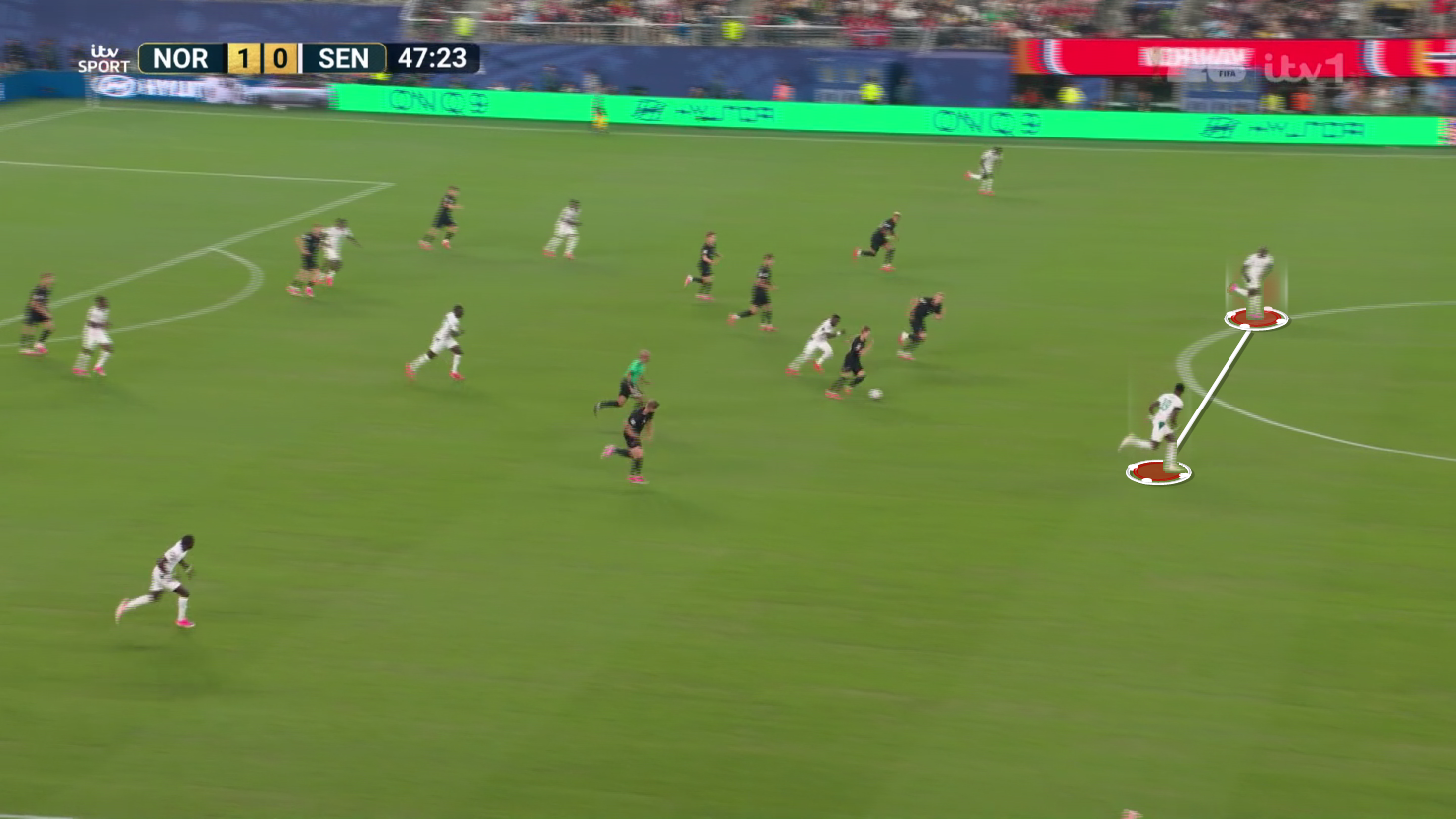
Since the start of the second half, Senegal chose to rely on a very high defensive line positioned inside Norway’s half, with no defender retreating to the midfield line to guarantee at least some security in case of a counterattack.
Using such an extremely high defensive block against a team with very powerful attacking players, notably Haaland, who loves situations that allow him to exploit space with his pace, was obviously a huge risk for Senegal.
Senegal could have been more patient and, at the very least, more organised at the back to avoid such counterattacks.
However, they cared only about getting back in the game, at the expense of preparing plans to prevent a potential second-goal opportunity.
With their extremely high line, Senegal made things easier for Norway in terms of goalscoring, as Norway struggled to create opportunities during the first half when Senegal were not using a very high defensive line.
As expected in such cases, Senegal's defenders struggled to defend as they retreated, allowing Haaland to score after an intelligent through pass from Ødegaard.
Haaland was quick enough to get past Koulibaly, receive the pass at his back, and execute a first-touch finish before Niakhaté arrives.
Norway Reliance On Erling Haaland As An Assist-Maker & Stationary Striker
In the first half, Norway’s attacks were infrequent, as their high-pressing system failed to prevent Senegal from circulating the ball in their own half.
Norway were not able to easily find spaces at the back of Senegal’s defensive line as they were unable to surprise them with frequent counter-attacks.
This led to relying mainly on crosses from the wings towards Haaland and Sørloth, which, by the way, was not a bad idea at all, given the extraordinary aerial abilities of both strikers, even though Sørloth was mainly playing on the right wing.
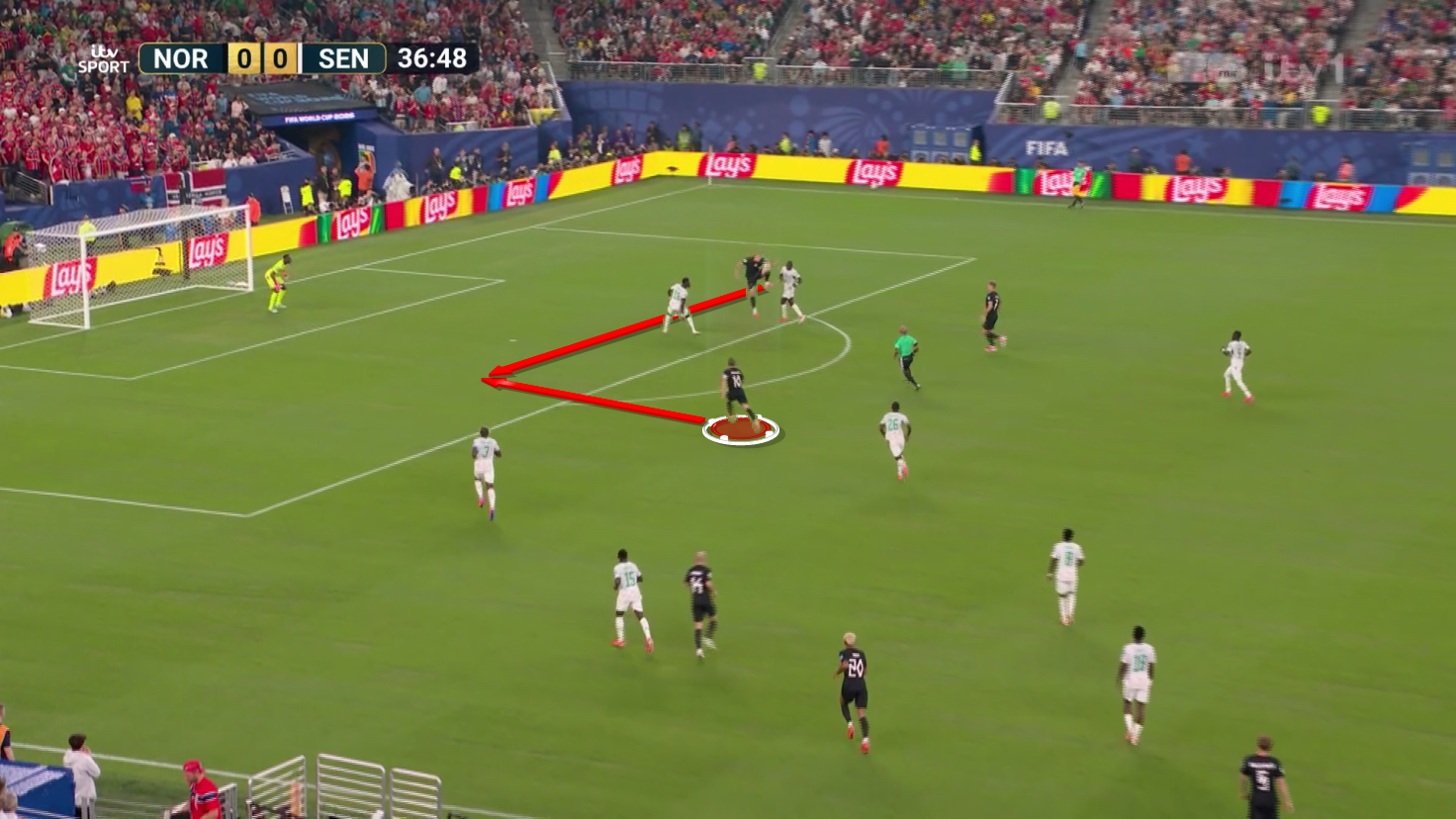
In fact, Norway’s reliance on both strikers, especially Haaland, was not just about accurately crossing to Haaland and letting him shoot on goal each time.
Norway made sure to accompany Haaland with a midfielder coming from behind to exploit the spaces left by Senegal’s defenders when they try to double-mark Haaland.
This strategy worked for Norway, and Haaland provided a key pass to Ødegaard, who came from behind, exploiting the completely empty space in front of him.
However, Ødegaard’s finishing was not as decisive as needed to beat Mendy.
Norway Attacking Depth Inside The Box
It is true that Haaland’s work as an assist-maker was not rewarding due to unsuccessful finishing, but he was crucial in terms of goalscoring as Norway intensified their attacks and advanced in numbers towards Senegal’s final third and penalty box.
![Olympique De Marseille Vs PSG [1-2] Ligue 1 2026/2027: How Bruno Génésio Transitions Troubled PSG - Tactical Analysis](https://cdn.mymidnight.blog/77f959f119f4fb2321e9ce801e2f5163/size/w600/2026/09/Marseille-Vs-PSG-2026_2027---Tactical-Analysis.png)
![Fulham Vs Manchester United [1-1] Premier League 2026/2027: How Álvaro Arbeloa Tactics Exposed The Red Devils' Problems - Tactical Analysis](https://cdn.mymidnight.blog/77f959f119f4fb2321e9ce801e2f5163/size/w600/2026/09/Fulham-FC-Vs-Man-United-2026_2027---Tactical-Analysis.png)
![AS Roma Vs Inter Milan [2-2] Serie A 2026/2027: When Undefeated Giallorossi Attack Met Nerazzurri Comeback Resilience - Tactical Analysis](https://cdn.mymidnight.blog/77f959f119f4fb2321e9ce801e2f5163/size/w600/2026/09/AS-Roma-Vs-Inter-Milan-2026_2027---Tactical-Analysis.png)
![Real Sociedad Vs Bournemouth [1-2] Europa League 2026/2027: How Do Marco Rose Pressing Tactics Work? - Tactical Analysis](https://cdn.mymidnight.blog/77f959f119f4fb2321e9ce801e2f5163/size/w600/2026/09/Real-Sociedad-Vs-Bournemouth-20262027---Tactical-Analysis-1.png)
![AC Milan Vs Benfica [0-2] Europa League 2026/2027: How Marco Silva Tactics Exposed Rúben Amorim Defensive Problems - Tactical Analysis](https://cdn.mymidnight.blog/77f959f119f4fb2321e9ce801e2f5163/size/w600/2026/09/AC-Milan-Vs-Benfica-20262027---Tactical-Analysis.png)
![Sunderland Vs AZ Alkmaar [1-0] Europa League 2026/2027: Why The Black Cats Make Better Underdogs - Tactical Analysis](https://cdn.mymidnight.blog/77f959f119f4fb2321e9ce801e2f5163/size/w600/2026/09/Sunderland-Vs-AZ-Alkmaar-20262027---Tactical-Analysis.png)
![Leeds United Vs Newcastle United [4-1] Premier League 2026/2027: Why Did Daniel Farke Tactics Dominate The Magpies? - Tactical Analysis](https://cdn.mymidnight.blog/77f959f119f4fb2321e9ce801e2f5163/size/w600/2026/09/Leeds-United-Vs-Newcastle-2026_2027---Tactical-Analysis.png)
![Real Sociedad Vs Atlético Madrid [0-3] La Liga 2026/2027: How Diego Simeone Tactical Precision Rescued A Late Victory - Tactical Analysis](https://cdn.mymidnight.blog/77f959f119f4fb2321e9ce801e2f5163/size/w600/2026/09/Real-Sociedad-Vs-Atl--tico-Madrid-20262027---Tactical-Analysis-1.png)