
![Uruguay Vs Cape Verde [2–2] – FIFA World Cup 2026: What's Gone Wrong For Marcelo Bielsa Tactics? – Tactical Analysis](https://cdn.mymidnight.blog/77f959f119f4fb2321e9ce801e2f5163/size/w1000/2026/06/Uruguay-Vs-Cape-Verde-World-Cup-2026.png)
Uruguay Vs Cape Verde [2–2] – FIFA World Cup 2026: What's Gone Wrong For Marcelo Bielsa Tactics? – Tactical Analysis

Marcelo Bielsa's Uruguay entered their second 2026 FIFA World Cup match under immense pressure after an opening-day draw against Saudi Arabia.
For their part, Cape Verde were coming off a monumental upset, arguably the biggest in this World Cup so far, after grinding out a 0-0 draw against tournament favourites Spain, in what was the first-ever World Cup match for a nation with a population of less than 500,000 people.
The truth is, the Cape Verdeans managed to pull it off again, severely damaging Los Charrúas' chances of qualifying for the knockout stages of this World Cup.
In yet another lacklustre display by Uruguay in their positional attacks, nerves dominated the Uruguayans for the vast majority of the match, completely exposing their structural flaws.
They looked far more comfortable attacking in open space rather than adapting to the positional structures required against the dense spaces proposed by the opponent's low block.
The offensive ambitions of Bielsa’s teams in the past, voracious in attack with high-tempo ball circulation driven by sharp off-the-ball movement, contrast sharply with this Uruguay side.
This Uruguay team adopt positional structures to overload the last line and the flanks, relying heavily on cross-and-volley situations.
Beyond Cape Verde's exploits, who once again surprised the world with their fearless style of play, this World Cup tactical analysis will dissect some of the main problems Uruguay tactics face during their periods of positional attack.
Uruguay Vs Cape Verde Lineups & Formations
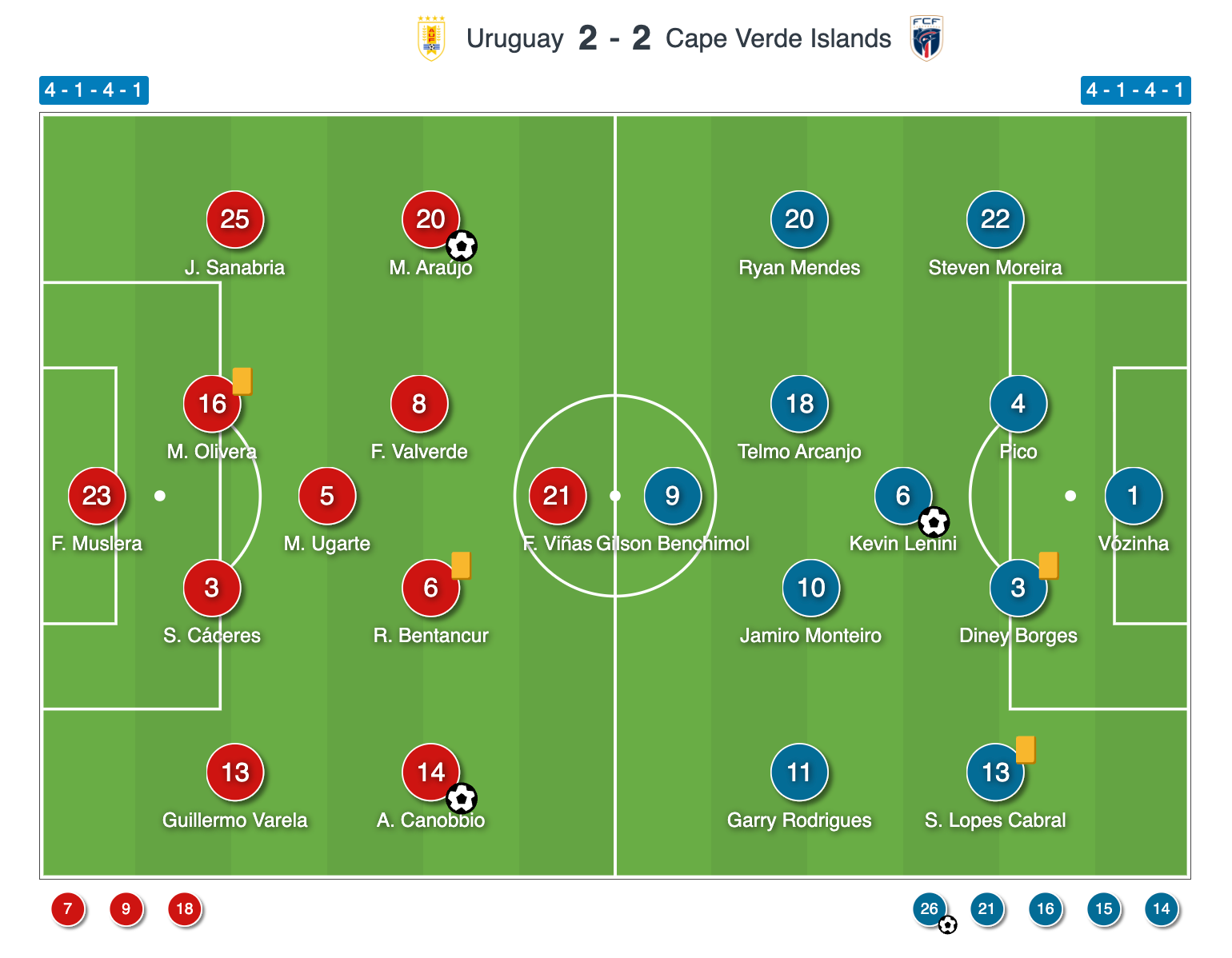
Uruguay Lineup Vs Cape Verde
Marcelo Bielsa set his team up in a 4-1-4-1 shape on paper.
Fernando Muslera played in goal, behind a back four of Guillermo Varela (right-back), Sebastián Cáceres (right centre-back), Mathías Olivera (left centre-back), and Juan Manuel Sanabria (left-back).
Manuel Ugarte played the holding midfield role, behind Rodrigo Bentancur and Federico Valverde in central midfield.
Agustín Canobbio and Maximiliano Araújo played on the right and left wing, respectively, with Federico Viñas leading the forward line.
Bielsa made a double-substitution in the 70th minute, as Viñas and Ugarte made way for Darwin Núñez and Nicolás de la Cruz.
Uruguay's third and final change came in the 81st minute, as Brian Rodríguez was introduced for Maximiliano Araújo.
Cape Verde Lineup Vs Uruguay
Bubista set Cape Verde up in a 4-1-4-1 shape too, with man of the match versus Spain, Vózinha, taking his place in goal again.
The back four consisted of Steven Moreira, Pico Lopes, Diney Borges and Sidny Lopes Cabral (from right to left).
Kevin Lenini played the holding midfield role, behind Telmo Arcanjo and Jamiro Monteiro in central midfield.
Ryan Mendes and Garry Rodrigues started on the right and left wings, respectively, with Gilson Benchimol starting up front.
The African side made five substitutions during the match.
Firstly, Deroy Duarte replaced Telmo Arcanjo at half-time.
Then, 13 minutes into the second half, Nuno da Costa and Hélio Varela came on for Gilson Benchimol and Garry Rodrigues, respectively.
Laros Duarte was introduced for Kevin Lenini in the 71st minute, and Cape Verde's final change saw Yannick Semedo replace Jamiro Monteiro in the 80th minute.
Uruguay's Width Problems Without Interior Play
To put it plainly, Uruguay’s primary issue in build-up is the fundamental incompatibility between their collective attacking intent and their players' natural characteristics.
Although Bielsa’s base formation throughout his tenure with Uruguay has been a 4-1-4-1/4-3-3, it drastically mutates into an aggressive 2-1-7 structure in possession.
This setup aims to push both full-backs and wingers to their maximum height, pinning the opponent's defence and creating a high density of players along the opposition's backline.
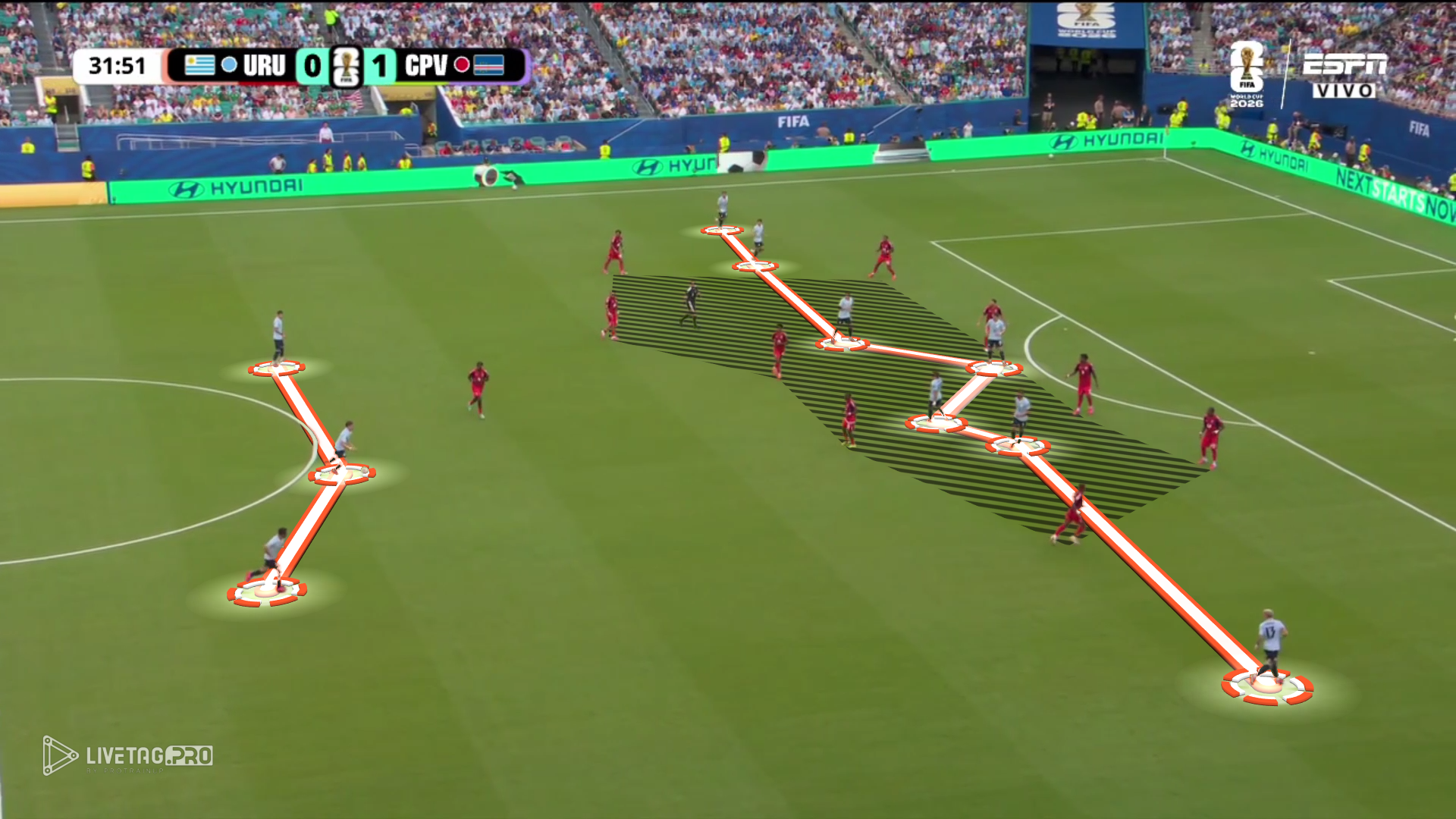
However, for such an attack-heavy structure to successfully dismantle low, compact, and hermetic defensive blocks like those deployed by Saudi Arabia and Cape Verde, having the tools to unbalance the opponent from central areas becomes indispensable.
In other words, they need to naturally and organically activate the half-spaces to progress.
This is precisely where La Celeste suffer from a lack of specific player profiles.
The players responsible for providing width (both full-backs and wingers) lack the associative tools or the self-sufficiency required to operate fluidly within tight spaces or between the lines.
Profiles like Maxi Araújo or Agustín Canobbio, who typically play for their clubs in systems that offer more longitudinal deployment as wing-backs and, logically, more open space, are inherently linear footballers.
Their ideal environment is exploiting space in depth through vertical runs, rather than static positional play or receiving with their back to goal.
Without wingers who naturally cut inside to act as interior receivers, and with both flanks operating on their natural foot, hugging the touchline, the team's dynamics inevitably become predictable.
Progression is reduced to wide carries and vertical runs down the line.
As a direct consequence, Uruguay's attacking pattern becomes unidimensional: the threat is channelled exclusively through width, forcing the baseline and severely limiting their pathways to goal.
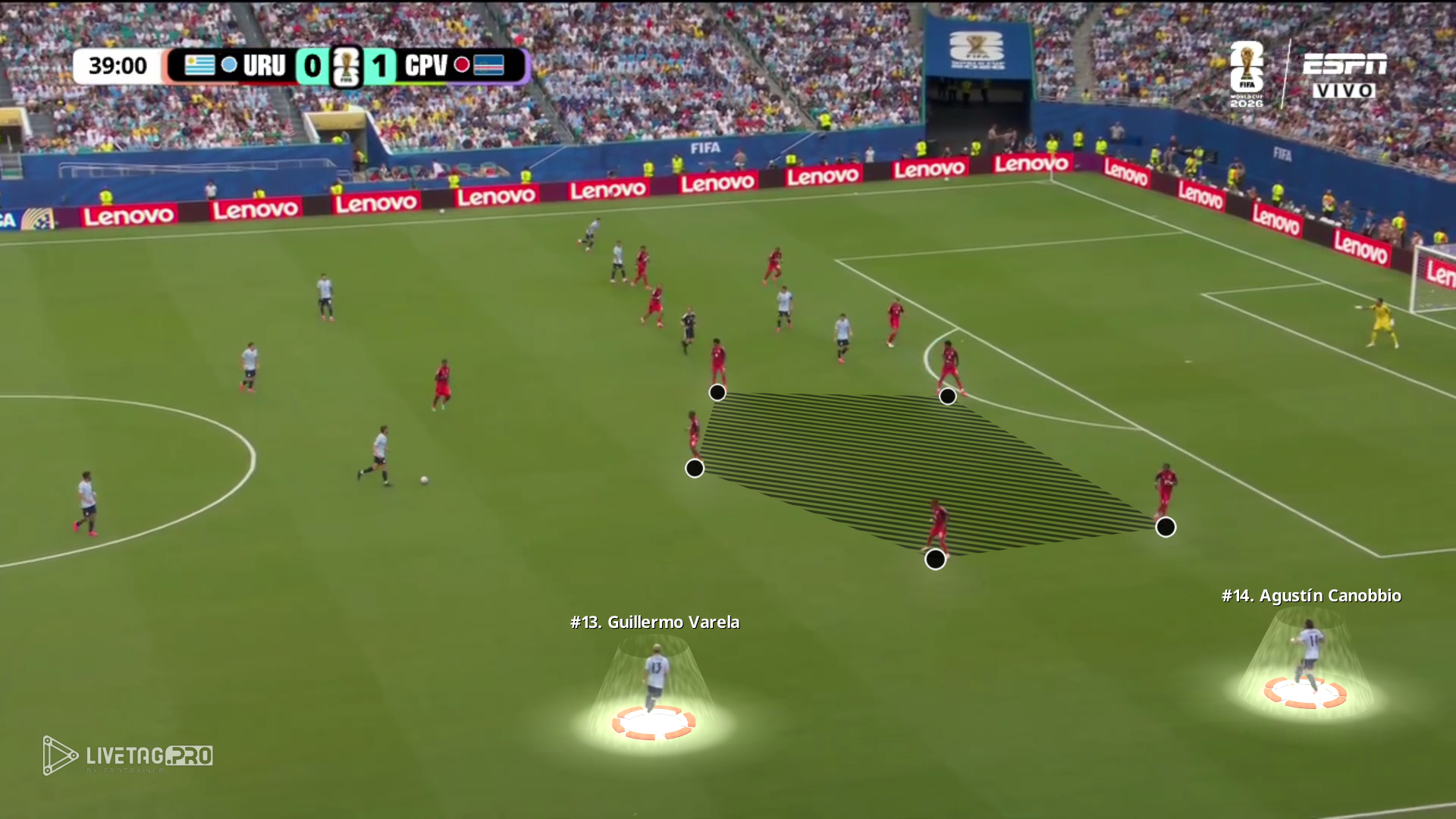
The progression is limited to wide carries and vertical runs down the line.
As a direct consequence, Uruguay’s attacking pattern becomes one-dimensional: danger is funnelled exclusively through width, forcing the baseline and narrowing their paths to goal.
Uruguay Midfield Disconnection
When width becomes the sole mechanism for progression, the only way to centralise the attack is through the compensation provided by the second line.
However, Uruguay’s midfield trio has not only failed to mitigate this issue, but has actually worsened the collective disconnection in the final third.
The pairing of Manuel Ugarte and Rodrigo Bentancur offers valuable traits, yet they are insufficient for this specific tactical context.
The Manchester United player is a specialist in defensive containment, crucial for providing balance during defensive transitions and dominating ground duels.
Meanwhile, the Tottenham Hotspur midfielder possesses excellent tempo management in early possession and offers stability at the base of the build-up.
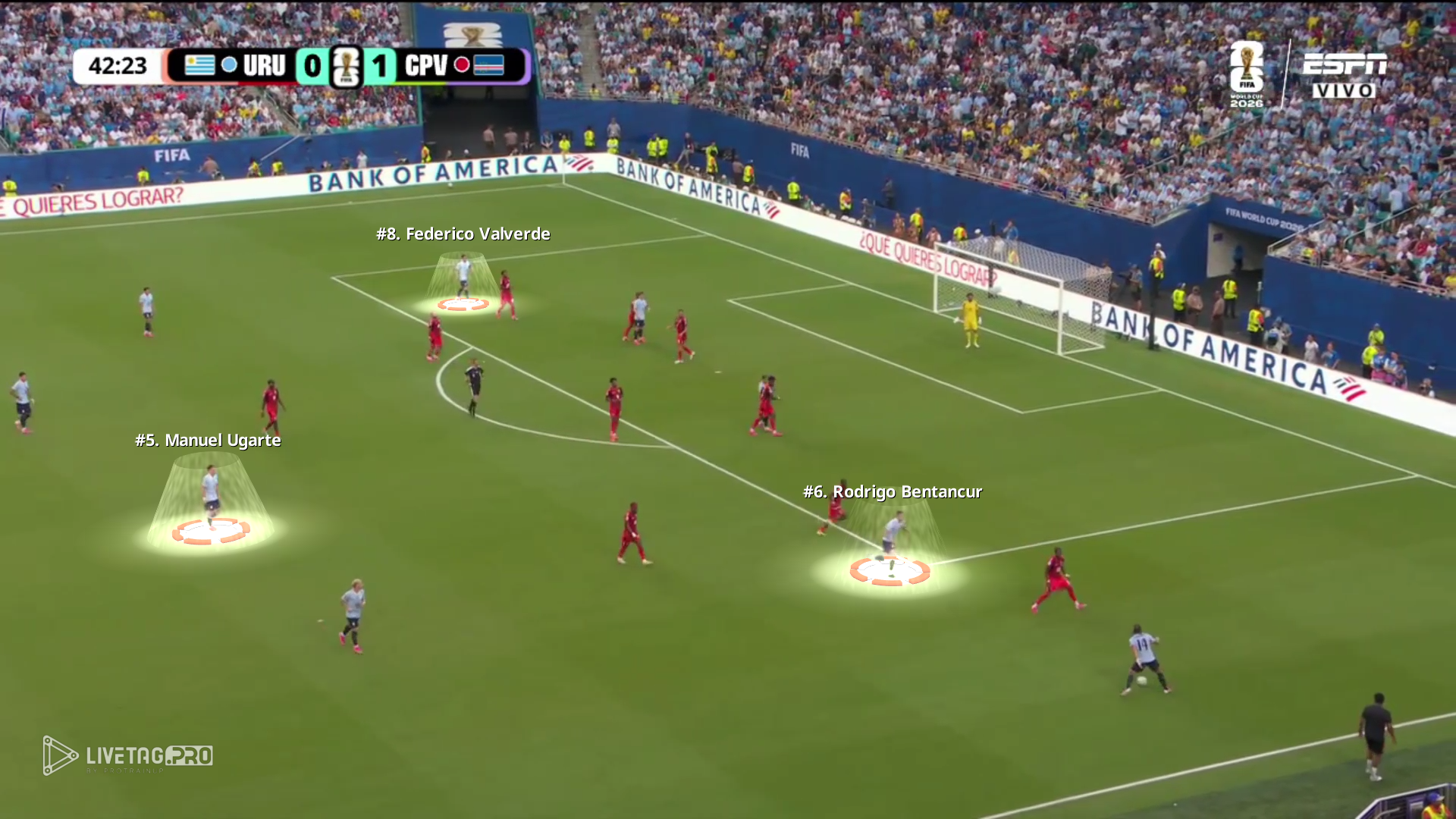
However, neither player stands out for their creativity in tight spaces.
Against deeply entrenched defences, the team sorely misses quick turns on the ball, body orientations that break lines, and high-tempo filtered passes capable of dismantling static structures.
The outlook does not improve when analysing Federico Valverde's role.
While he is the midfield's most technically gifted player, his differential qualities emerge when he has space ahead of him: receiving from deeper positions to activate his powerful stride in transition or arriving late to the edge of the box.
Forced to occupy higher positions within a highly compressed ecosystem, his ability to act as the primary creative engine is completely diluted, leaving the block devoid of an associative reference point in the creation zone.
Uruguay Dependence On Crosses
Faced with paralysis through the central channel, Bielsa's playbook has been reduced to two very specific wide options, yielding mixed results:
![Olympique De Marseille Vs PSG [1-2] Ligue 1 2026/2027: How Bruno Génésio Transitions Troubled PSG - Tactical Analysis](https://cdn.mymidnight.blog/77f959f119f4fb2321e9ce801e2f5163/size/w600/2026/09/Marseille-Vs-PSG-2026_2027---Tactical-Analysis.png)
![Fulham Vs Manchester United [1-1] Premier League 2026/2027: How Álvaro Arbeloa Tactics Exposed The Red Devils' Problems - Tactical Analysis](https://cdn.mymidnight.blog/77f959f119f4fb2321e9ce801e2f5163/size/w600/2026/09/Fulham-FC-Vs-Man-United-2026_2027---Tactical-Analysis.png)
![AS Roma Vs Inter Milan [2-2] Serie A 2026/2027: When Undefeated Giallorossi Attack Met Nerazzurri Comeback Resilience - Tactical Analysis](https://cdn.mymidnight.blog/77f959f119f4fb2321e9ce801e2f5163/size/w600/2026/09/AS-Roma-Vs-Inter-Milan-2026_2027---Tactical-Analysis.png)
![Real Sociedad Vs Bournemouth [1-2] Europa League 2026/2027: How Do Marco Rose Pressing Tactics Work? - Tactical Analysis](https://cdn.mymidnight.blog/77f959f119f4fb2321e9ce801e2f5163/size/w600/2026/09/Real-Sociedad-Vs-Bournemouth-20262027---Tactical-Analysis-1.png)
![AC Milan Vs Benfica [0-2] Europa League 2026/2027: How Marco Silva Tactics Exposed Rúben Amorim Defensive Problems - Tactical Analysis](https://cdn.mymidnight.blog/77f959f119f4fb2321e9ce801e2f5163/size/w600/2026/09/AC-Milan-Vs-Benfica-20262027---Tactical-Analysis.png)
![Sunderland Vs AZ Alkmaar [1-0] Europa League 2026/2027: Why The Black Cats Make Better Underdogs - Tactical Analysis](https://cdn.mymidnight.blog/77f959f119f4fb2321e9ce801e2f5163/size/w600/2026/09/Sunderland-Vs-AZ-Alkmaar-20262027---Tactical-Analysis.png)
![Leeds United Vs Newcastle United [4-1] Premier League 2026/2027: Why Did Daniel Farke Tactics Dominate The Magpies? - Tactical Analysis](https://cdn.mymidnight.blog/77f959f119f4fb2321e9ce801e2f5163/size/w600/2026/09/Leeds-United-Vs-Newcastle-2026_2027---Tactical-Analysis.png)
![Real Sociedad Vs Atlético Madrid [0-3] La Liga 2026/2027: How Diego Simeone Tactical Precision Rescued A Late Victory - Tactical Analysis](https://cdn.mymidnight.blog/77f959f119f4fb2321e9ce801e2f5163/size/w600/2026/09/Real-Sociedad-Vs-Atl--tico-Madrid-20262027---Tactical-Analysis-1.png)